Why Risk Becomes Invisible at the Leadership Level?
Risk doesn’t disappear in organizations.
It simply becomes harder to see.
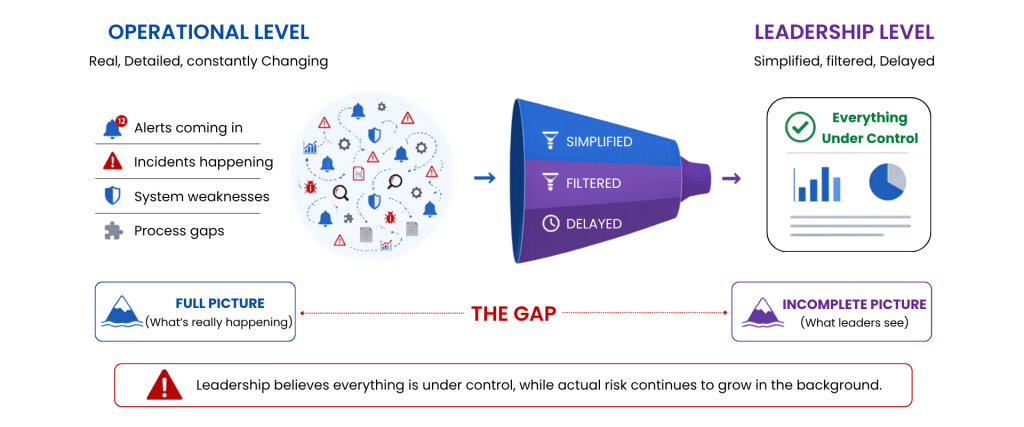
At the operational level, teams deal with risk every day.
They see:
- Alerts coming in
- Incidents happening
- System weaknesses
- Process gaps
Their view is real, detailed, and constantly changing. They understand how issues start, how they evolve, and how unpredictable they can be.
But as this information moves up to leadership, it changes. It gets:
- Simplified
- Filtered
- Delayed
This transformation is natural leaders cannot consume raw, complex data. They need summaries to make decisions.
However, in this process, important details are lost.
So by the time leaders see it, the picture is not wrong but it is incomplete.
This creates a serious gap:
Leadership believes everything is under control, while actual risk continues to grow in the background.
1. Complex Reality Gets Oversimplified
Organizations are complex systems where multiple things happen at the same time. Risks don’t always appear clearly, and many issues look small in the beginning.
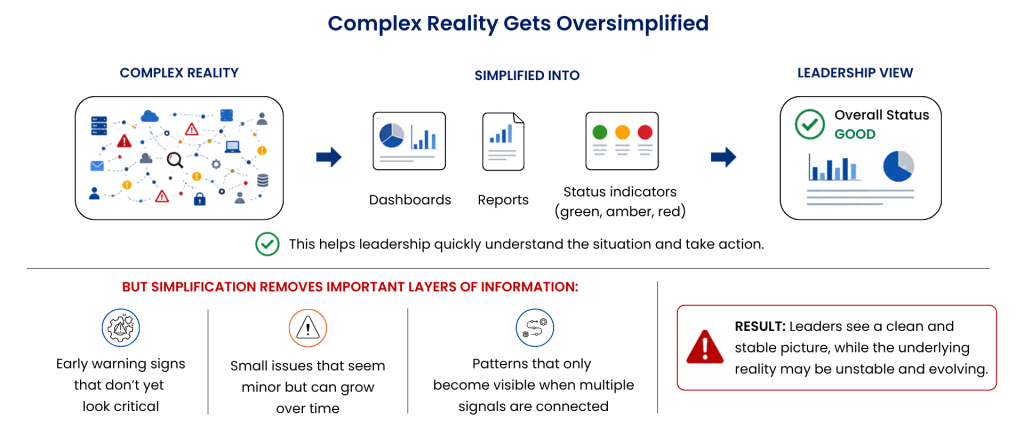
To make this manageable, complexity is converted into:
- Dashboards
- Reports
- Status indicators (green, amber, red)
This helps leadership quickly understand the situation and take action.
But simplification removes important layers of information:
- Early warning signs that don’t yet look critical
- Small issues that seem minor but can grow over time
- Patterns that only become visible when multiple signals are connected
For example, one failed login attempt may not matter. But repeated patterns across systems could indicate a serious threat — something dashboards may not highlight.
Result: Leaders see a clean and stable picture, while the underlying reality may be unstable and evolving.
2. Reports Show Progress, Not Risk
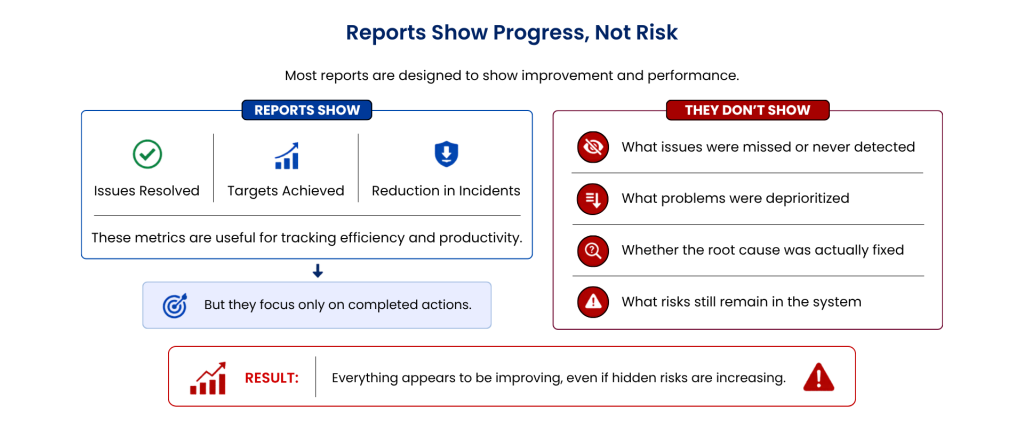
Most reports are designed to show improvement and performance, such as:
- Issues resolved
- Targets achieved
- Reduction in incidents
These metrics are useful for tracking efficiency and productivity.
But they focus only on completed actions.
They don’t show:
- What issues were missed or never detected
- What problems were deprioritized
- Whether the root cause was actually fixed
- What risks still remain in the system
For example, closing 100 incidents sounds positive but if critical issues were overlooked, the risk still exists.
Result: Everything appears to be improving, even if hidden risks are increasing.
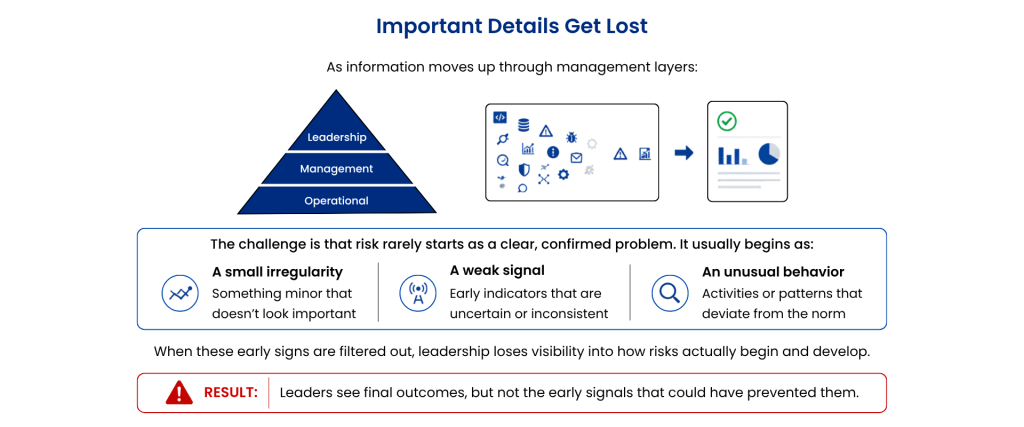
3. Important Details Get Lost
As information moves up through management layers:
- Technical details are removed to simplify communication
- Uncertain or unclear issues are often ignored
- Only confirmed and validated problems are reported
This makes the information easier to understand but less complete.
The challenge is that risk rarely starts as a clear, confirmed problem. It usually begins as:
- A small irregularity
- A weak signal
- An unusual behavior
When these early signs are filtered out, leadership loses visibility into how risks actually begin and develop.
Result: Leaders see final outcomes, but not the early signals that could have prevented them.
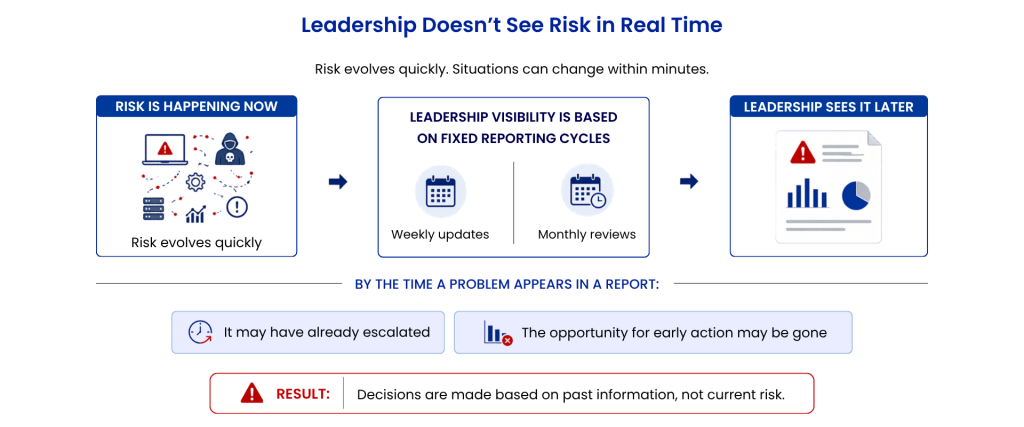
4. Leadership Doesn’t See Risk in Real Time
Risk evolves quickly. In areas like cybersecurity or operations, situations can change within minutes.
But leadership visibility is based on fixed reporting cycles:
- Weekly updates
- Monthly reviews
This creates a time gap:
- Risk is happening now
- Leadership sees it later
By the time a problem appears in a report:
- It may have already escalated
- The opportunity for early action may be gone
Result: Decisions are made based on past information, not current risk.
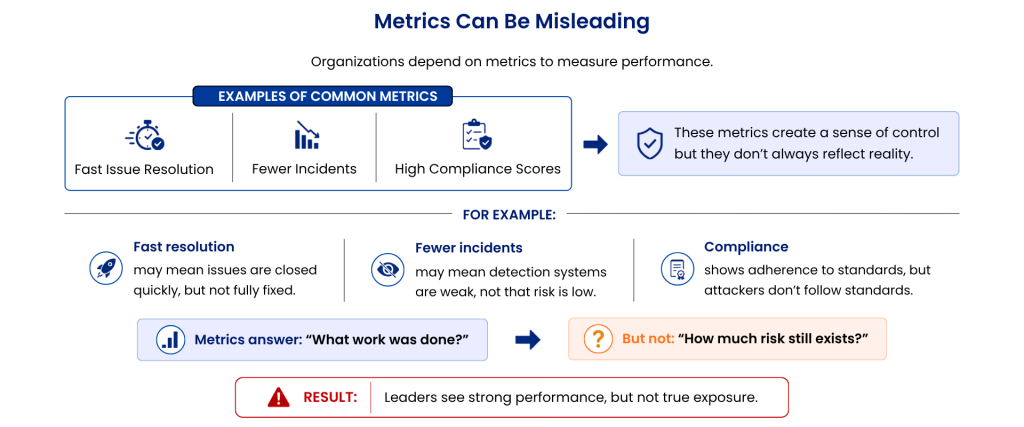
5. Metrics Can Be Misleading
Organizations depend on metrics to measure performance, such as:
- Fast issue resolution
- Fewer incidents
- High compliance scores
These metrics create a sense of control but they don’t always reflect reality.
For example:
- Fast resolution may mean issues are closed quickly, but not fully fixed
- Fewer incidents may mean detection systems are weak, not that risk is low
- Compliance shows adherence to standards, but attackers don’t follow standards
Metrics answer:
“What work was done?”
But not:
“How much risk still exists?”
Result: Leaders see strong performance, but not true exposure.
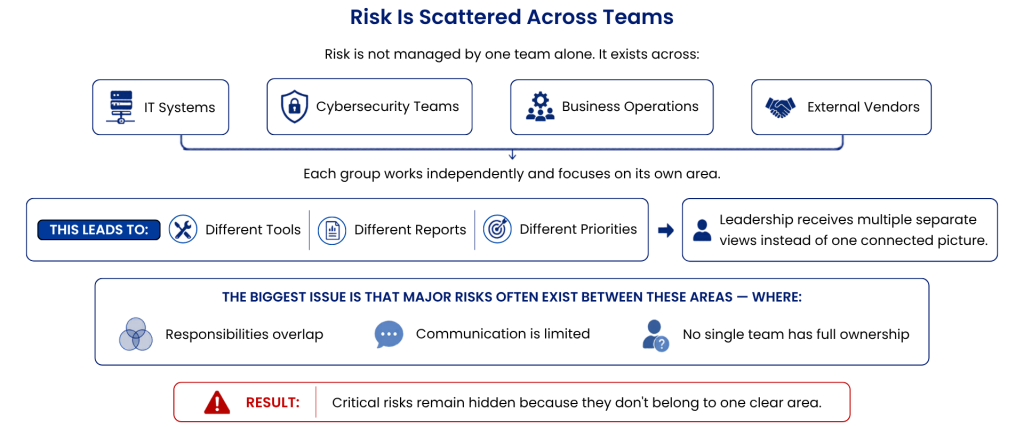
6. Risk Is Scattered Across Teams
Risk is not managed by one team alone. It exists across:
- IT systems
- Cybersecurity teams
- Business operations
- External vendors
Each group works independently and focuses on its own area.
This leads to:
- Different tools
- Different reports
- Different priorities
Leadership receives multiple separate views instead of one connected picture.
The biggest issue is that major risks often exist between these areas where:
- Responsibilities overlap
- Communication is limited
- No single team has full ownership
Result: Critical risks remain hidden because they don’t belong to one clear area.
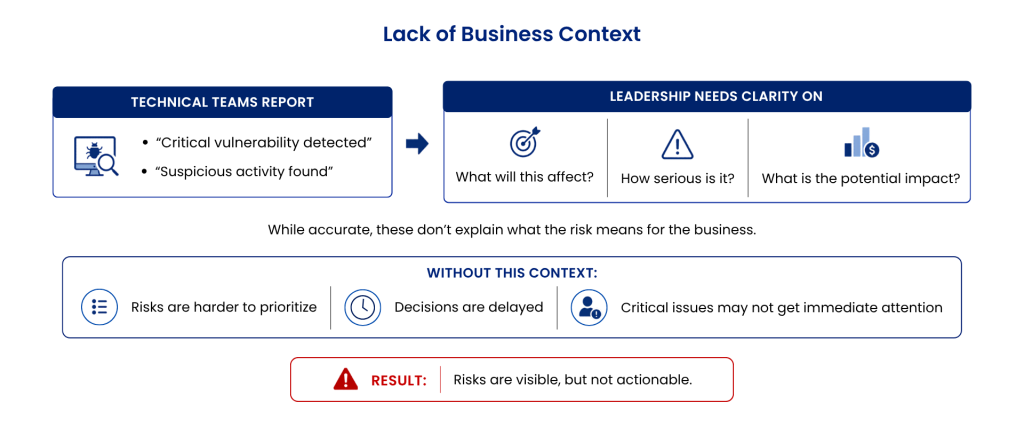
7. Lack of Business Context
Technical teams usually report issues in technical terms, such as:
- “Critical vulnerability detected”
- “Suspicious activity found”
While accurate, these don’t explain what the risk means for the business.
Leadership needs clarity on:
- What will this affect?
- How serious is it?
- What is the potential impact?
Without this context:
- Risks are harder to prioritize
- Decisions are delayed
- Critical issues may not get immediate attention
Result: Risks are visible, but not actionable.
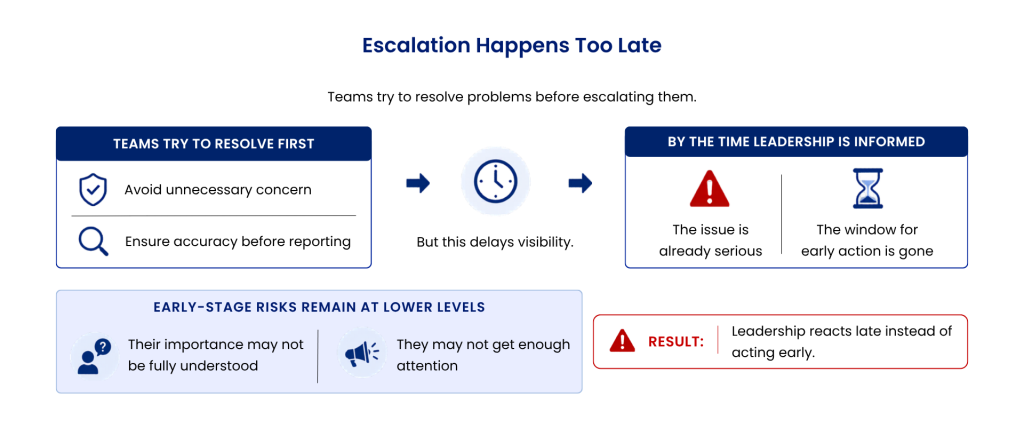
8. Escalation Happens Too Late
In many organizations, teams try to resolve problems before escalating them. This is often done to:
- Avoid unnecessary concern
- Ensure accuracy before reporting
But this delays visibility.
By the time leadership is informed:
- The issue is already serious
- The window for early action is gone
Early-stage risks remain at lower levels,
where:
- Their importance may not be fully understood
- They may not get enough attention
Result: Leadership reacts late instead of acting early.
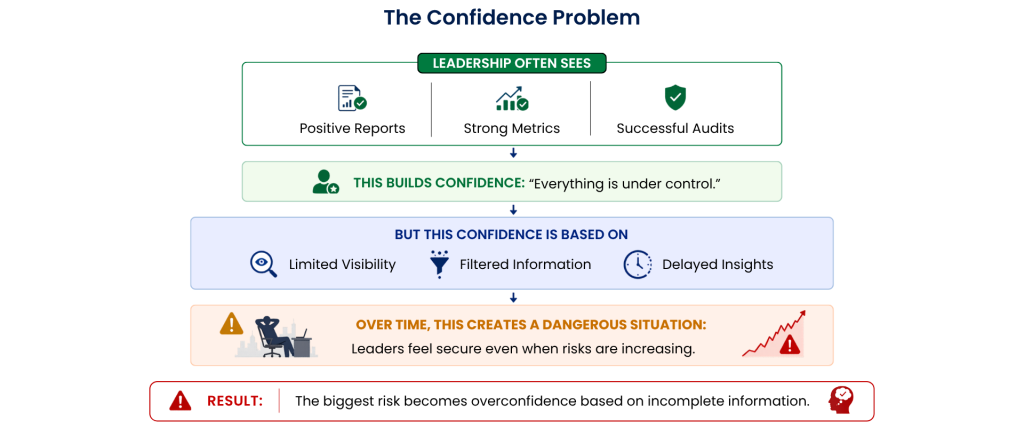
9. The Confidence Problem
Leadership often sees:
- Positive reports
- Strong metrics
- Successful audits
This builds confidence:
“Everything is under control.”
But this confidence is based on:
- Limited visibility
- Filtered information
- Delayed insights
Over time, this creates a dangerous situation:
Leaders feel secure even when risks are increasing.
Result: The biggest risk becomes overconfidence based on incomplete information.
The Core Issue
At the ground level:
- Risk is complex, dynamic, and uncertain
At the leadership level:
- Everything appears stable, structured, and controlled
Both views are correct but neither is complete.
The real problem is the gap between what is happening and what is being seen.
This gap leads to:
- Misinformed decisions
- Delayed responses
- Underestimated risks
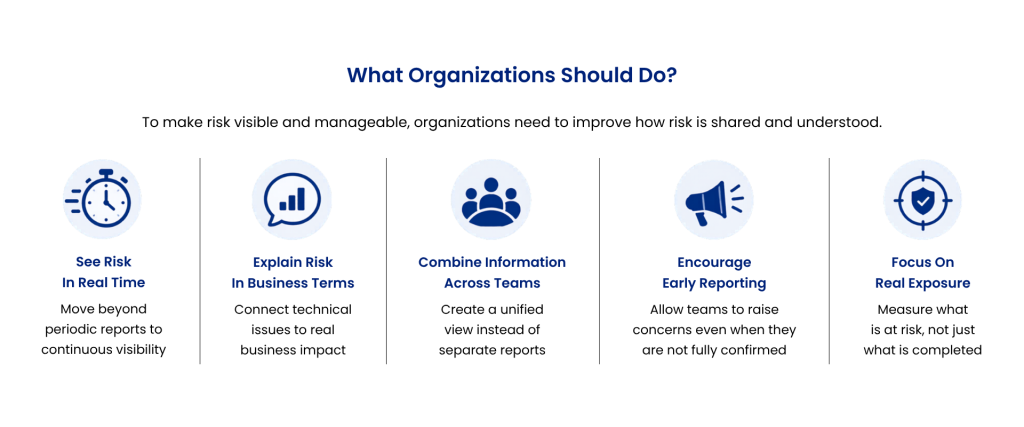
What Organizations Should Do
To make risk visible and manageable, organizations need to improve how risk is shared and understood:
- See risk in real time
Move beyond periodic reports to continuous visibility - Explain risk in business terms
Connect technical issues to real business impact - Combine information across teams
Create a unified view instead of separate reports - Encourage early reporting
Allow teams to raise concerns even when they are not fully confirmed - Focus on real exposure
Measure what is at risk, not just what is completed
Final Thought
Risk becomes dangerous not when it increases but when it becomes invisible.
And invisibility doesn’t happen suddenly.
It is created over time through:
- Simplification
- Filtering
- Delayed visibility
- Fragmented communication
The goal is not just to manage risk, but to ensure leadership can clearly see it, understand it, and act on it at the right time.