How Enterprise Architecture Fails Over Time?
Enterprise architecture rarely collapses overnight. It erodes—quietly, gradually, and often invisibly. What begins as a well-structured, scalable system slowly transforms into a fragile, overcomplicated environment where risk accumulates faster than anyone realizes.
The most dangerous part? This decline doesn’t trigger alarms. Systems continue to function. Reports still generate. Applications still run. But beneath the surface, structural integrity weakens—until small issues cascade into major failures.
This is how enterprise architecture fails—not dramatically, but silently.
The Illusion of Stability
In the early stages, architecture is intentional. Systems are designed with clear boundaries, integrations are thoughtfully planned, and scalability is considered.
Over time, however, business demands accelerate:
- New features are prioritized over architectural consistency
- Integrations are added quickly to meet deadlines
- Short-term fixes replace long-term thinking
Each decision makes sense in isolation. None seem risky on their own.
But architecture doesn’t fail because of one bad decision—it fails because of hundreds of reasonable ones.
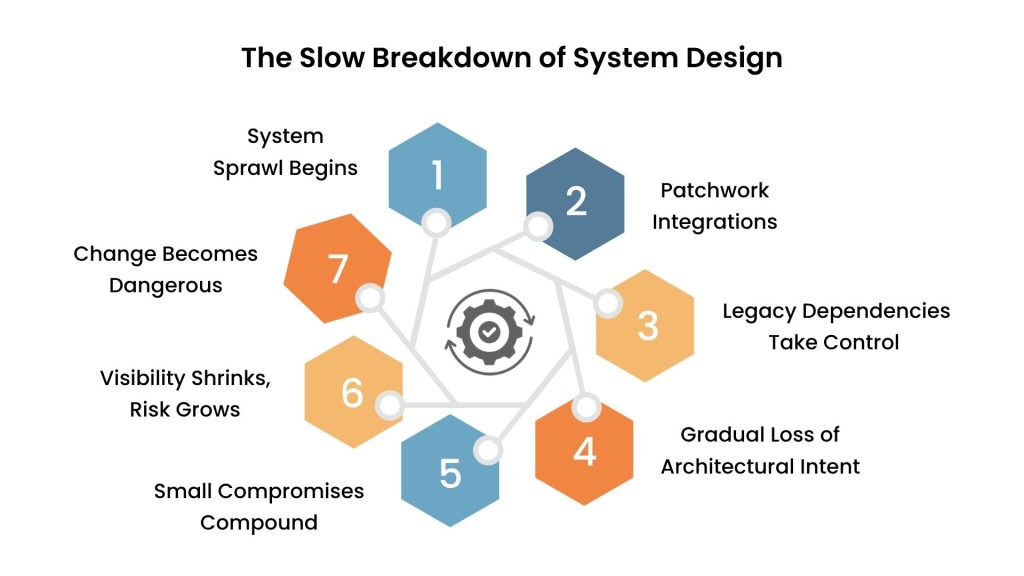
Phase 1: System Sprawl Begins
Growth introduces complexity.
New tools, platforms, and services are added to support evolving needs:
- Teams adopt specialized tools to move faster
- Legacy systems remain because replacing them is risky
- Redundant solutions emerge across departments
What starts as flexibility becomes fragmentation.
Instead of a cohesive architecture, organizations end up with:
- Multiple systems performing similar functions
- Inconsistent data models across platforms
- Limited visibility across the ecosystem
Sprawl doesn’t feel like failure—it feels like progress. But every new system increases the surface area for risk.
Phase 2: Patchwork Integrations
As systems multiply, integration becomes the glue holding everything together.
But under pressure, integration is rarely elegant:
- APIs are built quickly without standardization
- Point-to-point connections replace scalable integration layers
- Data transformations are handled inconsistently
Over time, integration resembles a patchwork rather than a framework.
This creates:
- Hidden dependencies between systems
- Fragile data flows that break under change
- Limited traceability when issues occur
The architecture still works—but only under specific conditions. Change anything, and unexpected failures emerge.
Phase 3: Legacy Dependencies Take Control
Legacy systems don’t disappear—they accumulate.
They persist because:
- They support critical business processes
- Replacing them is expensive and risky
- Knowledge about them becomes scarce
Eventually, architecture starts revolving around legacy constraints instead of business goals.
This leads to:
- Modern systems adapting to outdated limitations
- Increased effort required for even minor changes
- Reduced ability to innovate
The organization doesn’t control its architecture anymore—the architecture controls the organization.
Phase 4: Gradual Loss of Architectural Intent
At this stage, the original design principles are no longer visible.
What was once:
- Modular
- Scalable
- Governed
Becomes:
- Tightly coupled
- Hard to scale
- Poorly documented
Why this happens:
- Documentation becomes outdated
- Original architects leave
- New teams optimize locally, not globally
Without a shared architectural vision, decisions become reactive rather than strategic.
The system still functions—but no one fully understands how.
Phase 5: Small Compromises Compound
Every workaround introduces a small inconsistency:
- A temporary fix becomes permanent
- A shortcut becomes standard practice
- An exception becomes the rule
Individually, these compromises seem harmless.
Collectively, they create:
- Inconsistent system behavior
- Increased operational complexity
- Difficulty in troubleshooting
This is where risk starts to compound exponentially.
Not because of major flaws—but because of accumulated micro-decisions.
Phase 6: Visibility Shrinks, Risk Grows
As complexity increases, visibility decreases.
Organizations begin to experience:
- Monitoring gaps across systems
- Alert noise masking real issues
- Incomplete understanding of dependencies
Problems don’t disappear—they become harder to detect.
This leads to:
- Delayed incident response
- Misdiagnosed failures
- Increased downtime impact
At this stage, architecture is no longer transparent. It becomes opaque and unpredictable.
Phase 7: Change Becomes Dangerous
One of the clearest signs of architectural failure is fear of change.
Teams hesitate to:
- Deploy updates
- Modify integrations
- Replace outdated components
Because:
- The impact of change is unpredictable
- Dependencies are unclear
- Failures are difficult to isolate
When change becomes risky, innovation slows.
The system isn’t just complex—it’s fragile.
The Tipping Point: When Failure Becomes Visible
For years, the architecture appears to function.
Then suddenly:
- A minor update triggers a major outage
- A system dependency fails unexpectedly
- Data inconsistencies impact business decisions
These events feel sudden—but they aren’t.
They are the result of years of accumulated architectural drift.
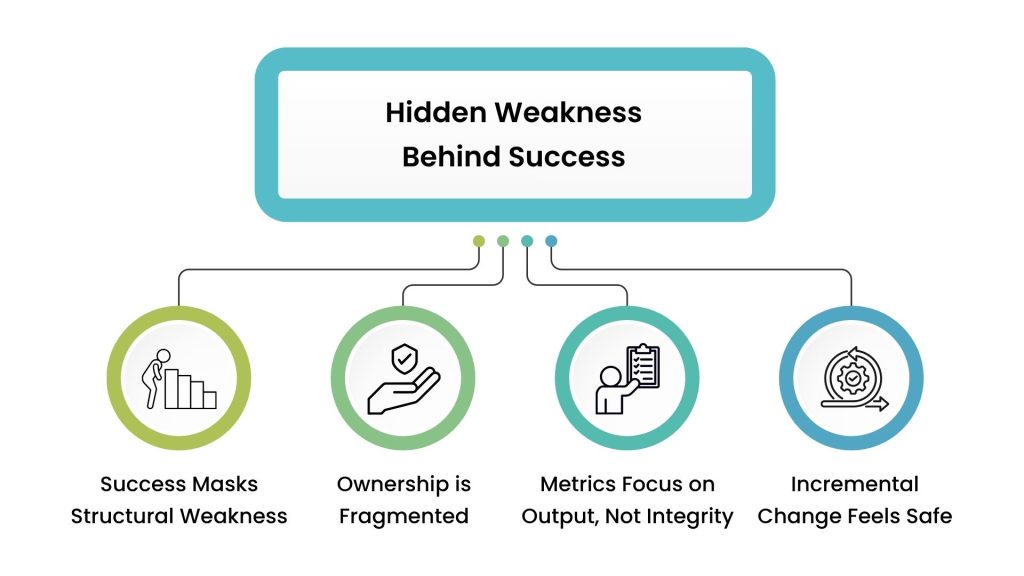
Why No One Notices
Enterprise architecture fails quietly because:
1. Success Masks Structural Weakness
As long as systems work, underlying issues remain hidden.
2. Ownership is Fragmented
No single team sees the entire system.
3. Metrics Focus on Output, Not Integrity
Performance is measured—but structural health isn’t.
4. Incremental Change Feels Safe
Gradual degradation is harder to detect than sudden failure.
The Real Risk: Invisible Complexity
The most dangerous architectures aren’t broken—they’re deceptively functional.
They:
- Deliver results
- Support operations
- Enable short-term progress
But underneath:
- Complexity grows unchecked
- Dependencies multiply
- Risk accumulates silently
This is invisible complexity—and it’s the root of long-term failure.
Preventing Silent Architectural Failure
Avoiding this outcome requires deliberate intervention.
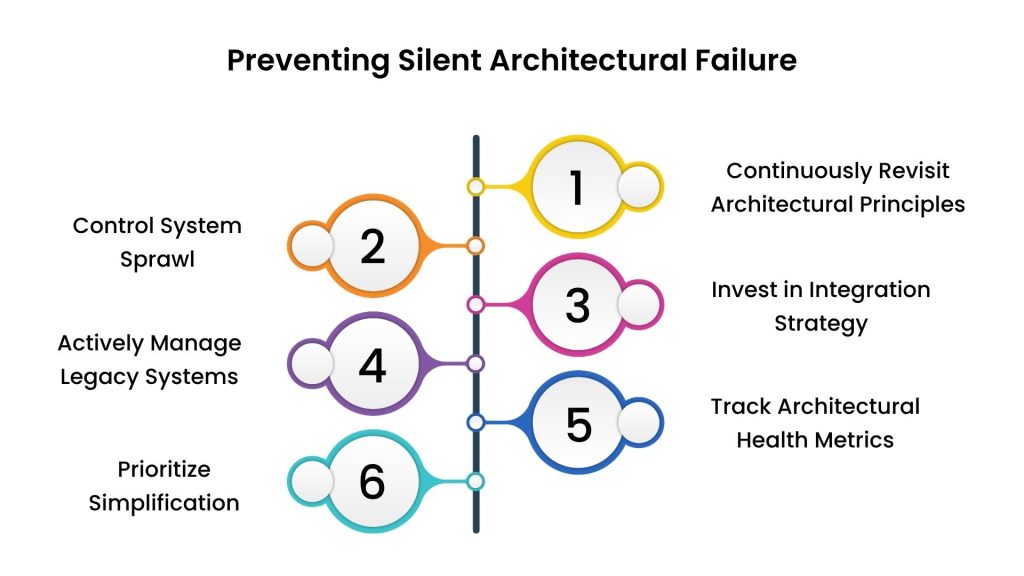
1. Continuously Revisit Architectural Principles
Architecture must evolve intentionally—not accidentally.
2. Control System Sprawl
Standardize tools and reduce redundancy.
3. Invest in Integration Strategy
Move from point-to-point connections to structured integration layers.
4. Actively Manage Legacy Systems
Don’t let them dictate future design decisions.
5. Track Architectural Health Metrics
Measure:
- Dependency complexity
- Integration density
- Change failure rates
6. Prioritize Simplification
Complexity doesn’t reduce itself—it must be actively removed.
Final Thought
Enterprise architecture doesn’t fail because teams are careless.
It fails because:
- Short-term decisions are prioritized
- Complexity is underestimated
- Structural integrity is not continuously managed
The danger isn’t rapid collapse—it’s slow decay.
And by the time the failure becomes visible, the cost of fixing it is exponentially higher.
The real challenge isn’t building architecture.
It’s preventing it from quietly falling apart.