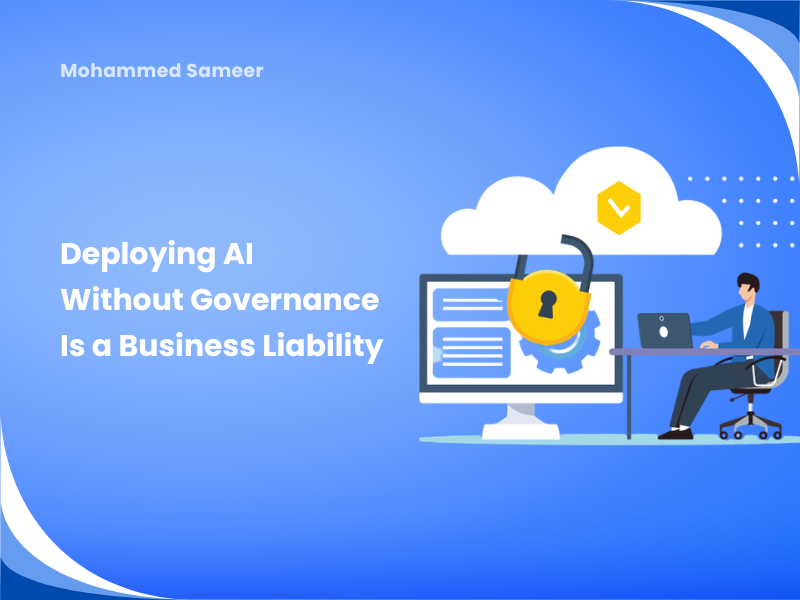
Deploying AI Without Governance Is a Business Liability
A Deep Dive into Model Risk, Auditability, and Compliance Pressure
Artificial Intelligence is now embedded in enterprise decision systems — from credit scoring and fraud analytics to supply chain optimization, HR screening, cybersecurity triage, and executive forecasting.
Unlike traditional software, AI systems:
- Learn from historical patterns
- Adapt to new data inputs
- Produce probabilistic outcomes
- Influence high-impact business decisions
This makes AI powerful — and uniquely risky.
When deployed without governance, AI becomes a risk multiplier. The liability is not limited to technical malfunction. It extends to regulatory exposure, reputational damage, financial loss, and board-level accountability.
Three core exposure domains define the liability landscape:
- Model Risk
- Auditability & Traceability Gaps
- Regulatory & Compliance Escalation
Below is a detailed breakdown of each.
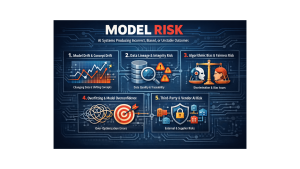
I. Model Risk: Structural Vulnerabilities in AI Systems
Model risk refers to the possibility that AI systems produce incorrect, biased, unstable, or legally problematic outcomes.
1. Model Drift and Concept Drift
AI models are trained on historical datasets. However, real-world environments change:
- Economic shifts alter customer behavior
- Fraud patterns evolve
- Regulatory definitions change
- Market volatility introduces new variables
Two forms of degradation occur:
- Data Drift: Input data distribution shifts from training data
- Concept Drift: The relationship between inputs and outputs changes
Without automated monitoring, performance degradation is silent.
Consequences:
- False approvals in credit systems
- Missed fraud alerts
- Incorrect demand forecasts
- Inaccurate risk ratings
Drift is dangerous because it often remains undetected until losses accumulate.
Governance Requirement:
- Performance thresholds
- Automated retraining triggers
- Continuous validation pipelines
- Documented recalibration protocols
2. Data Lineage & Integrity Risk
AI models rely on complex data pipelines involving:
- Multiple internal systems
- Third-party APIs
- External datasets
- Real-time data streams
Without governance:
- Data ownership is unclear
- Source integrity is undocumented
- Data transformation logic is opaque
- Feature engineering lacks traceability
If regulators or auditors ask:
“Where did this decision input originate?”
Many organizations cannot answer confidently.
Governance controls must include:
- End-to-end data lineage mapping
- Dataset versioning
- Data quality scoring
- Access controls and encryption
- Documented transformation logic
AI is only as trustworthy as its data chain.
3. Algorithmic Bias & Fairness Risk
Bias in AI can emerge from:
- Historical discrimination embedded in training data
- Proxy variables (e.g., zip codes correlating with protected attributes)
- Imbalanced datasets
- Feature engineering decisions
This creates potential violations of anti-discrimination laws and fairness standards.
Under the EU AI Act, high-risk AI systems must implement structured risk management, bias mitigation, and transparency measures.
Under the General Data Protection Regulation, individuals have rights related to automated decision-making and explanation.
Bias exposure leads to:
- Legal action
- Regulatory penalties
- Public scrutiny
- Reputational damage
Governance mechanisms should include:
- Fairness testing across demographic segments
- Statistical parity analysis
- Disparate impact testing
- Ethical review committees
- Human override policies
Bias is not only an ethical issue — it is a compliance and litigation risk.
4. Overfitting & Model Overconfidence
Overfitted models perform well in testing but fail in real-world deployment.
Without governance:
- Validation datasets are insufficiently separated
- Testing methodologies are weak
- Performance metrics are poorly selected
This creates false confidence at deployment.
Governance demands:
- Independent validation teams
- Out-of-sample testing
- Stress testing under extreme scenarios
- Documented model approval processes
5. Third-Party & Vendor AI Risk
Many organizations rely on:
- SaaS-based AI platforms
- Embedded AI within enterprise software
- External model providers
Risk emerges when:
- Model logic is proprietary and opaque
- Data processing agreements are unclear
- Liability boundaries are ambiguous
Governance must extend to vendor due diligence:
- Contractual transparency clauses
- Model documentation access rights
- Security assessment reviews
- Compliance certification verification
AI risk does not disappear when outsourced.
II. Auditability & Traceability: Defensibility Under Scrutiny
If AI influences decisions affecting customers, employees, or financial reporting, it must be defensible.
1. Model Lifecycle Governance
A defensible AI lifecycle includes:
- Business case justification
- Risk classification
- Data sourcing approval
- Development documentation
- Validation testing
- Deployment authorization
- Continuous monitoring
- Periodic re-certification
Without structured lifecycle control:
- Model versions cannot be reconstructed
- Historical decisions cannot be replicated
- Approval authorities are unclear
In high-regulation sectors, this is unacceptable.
The National Institute of Standards and Technology AI Risk Management Framework emphasizes governance structures, transparency, and accountability as core pillars.
2. Explainability & Decision Reconstruction
High-impact AI decisions require:
- Feature contribution visibility
- Reason codes
- Confidence intervals
- Human review documentation
When facing legal or regulatory challenge, organizations must demonstrate:
- Why the decision occurred
- What data influenced it
- Whether bias testing was conducted
- Whether oversight was applied
Black-box opacity becomes a litigation vulnerability.
3. Documentation as Legal Shield
Governance requires structured documentation:
- Model registry
- Validation reports
- Drift monitoring logs
- Bias assessments
- Incident reports
- Exception approvals
Documentation is not administrative overhead.
It is legal protection.
If an organization cannot prove governance existed at decision time, retrospective reconstruction is nearly impossible.
III. Escalating Regulatory & Compliance Pressure
AI regulation is accelerating globally.
The EU AI Act introduces:
- Risk-based classification
- Mandatory conformity assessments
- Transparency obligations
- Fines for non-compliance
The General Data Protection Regulation enforces:
- Data minimization
- Purpose limitation
- Rights related to automated decision-making
The National Institute of Standards and Technology AI Risk Management Framework provides structured guidance adopted across industries.
Additionally, financial regulators increasingly expect formal Model Risk Management (MRM) programs for AI-enabled systems.
Compliance pressure manifests through:
- Board-level risk inquiries
- Internal audit reviews
- External regulatory audits
- Investor scrutiny
- Cyber insurance underwriting reviews
AI governance is becoming embedded within enterprise risk management (ERM) structures.
IV. Financial & Strategic Consequences of Governance Failure
Failure to govern AI properly results in:
- Regulatory fines
- Class-action lawsuits
- Brand erosion
- Customer trust decline
- Increased capital reserve requirements
- Higher audit costs
- Operational remediation programs
More subtly:
- AI initiatives stall due to internal resistance
- Innovation slows because trust erodes
- Board approval becomes difficult
Governance enables scale.
Without it, AI initiatives fragment.
V. What Enterprise-Grade AI Governance Looks Like
A mature governance framework includes:
1. Centralized AI Inventory
Every AI system cataloged with:
- Owner
- Risk tier
- Business purpose
- Data inputs
- Deployment environment
2. Risk Tiering Framework
Models classified by impact level:
- Informational
- Operational
- Financial
- Legal / High-risk
Each tier mandates escalating review controls.
3. Independent Model Validation
Separate oversight from development.
4. Continuous Monitoring Infrastructure
- Real-time performance dashboards
- Drift detection automation
- Bias monitoring alerts
5. Formal AI Governance Committee
Cross-functional representation:
- Legal
- Risk
- Compliance
- Data Science
- IT Security
- Executive leadership
6. Board Reporting Integration
AI risk metrics integrated into:
- Enterprise risk dashboards
- Strategic risk discussions
- Annual governance reviews
Executive Conclusion
AI is not just a technology deployment decision.
It is a structural risk decision.
Deploying AI without governance means:
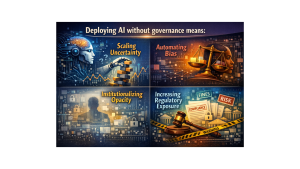
- Scaling uncertainty
- Automating bias
- Institutionalizing opacity
- Increasing regulatory exposure
The competitive advantage in the AI era will not come from deploying more models.
It will come from deploying models that are:
- Transparent
- Monitored
- Documented
- Accountable
- Defensible
AI without governance is not innovation.
It is unmanaged liability — amplified by automation.