AI Risk Isn’t Technical — It’s Organizational
ATC: Accountability, Misuse, and Decision Ownership
Most AI risk discussions focus on models, data quality, hallucinations, bias mitigation, and cybersecurity. Those issues matter — but they are not where the biggest failures originate.
The most significant AI breakdowns are rarely caused by the model itself.
They are caused by unclear ownership, informal usage patterns, and ungoverned decision-making.
AI risk is fundamentally organizational.
To manage it properly, leadership must shift from a purely technical lens to an ATC framework:
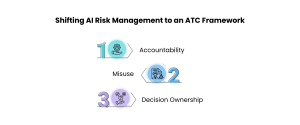
- Accountability
- Misuse
- Decision Ownership
This is where real risk lives.
1. The Illusion of “Technical Control”
Enterprises often respond to AI adoption by building technical guardrails:
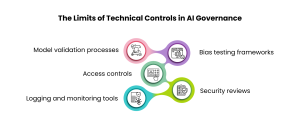
- Model validation processes
- Bias testing frameworks
- Access controls
- Logging and monitoring tools
- Security reviews
These controls are necessary — but insufficient.
Why?
Because AI does not operate in isolation. It operates inside workflows, incentives, power structures, and performance metrics. When those elements are misaligned, technical controls are quietly bypassed.
For example:
- A sales team under aggressive targets uses AI to generate client messaging without compliance review.
- A hiring manager relies heavily on AI-generated candidate summaries.
- A finance team automates forecasting outputs without manual verification.
The systems may be secure and validated.
The decisions may not be.
This gap is where organizational risk emerges.
2. Accountability: The Missing Anchor
The first and most critical ATC pillar is accountability.
In many organizations, AI sits in a gray zone:
- IT manages the platform.
- Data teams manage the model.
- Business units use the outputs.
- Risk and compliance issue policies.
- Legal gets involved after incidents.
But who owns the outcome?
When accountability is diffused, responsibility disappears.
True AI accountability requires:
Clear Executive Ownership
There must be a named executive responsible for:
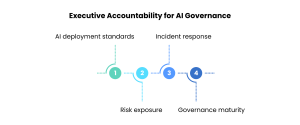
- AI deployment standards
- Risk exposure
- Incident response
- Governance maturity
Without executive-level ownership, AI governance becomes advisory instead of authoritative.
Defined Escalation Pathways
When AI produces questionable output:
- Who is notified?
- Who decides whether to halt usage?
- Who communicates externally if required?
Ambiguity during incidents amplifies damage.
Performance Alignment
If leaders are rewarded only for speed and innovation, risk management becomes secondary. Accountability must be tied to measurable KPIs — not just productivity metrics.
If no one’s performance review reflects AI risk outcomes, accountability is performative.
3. Misuse: The Behavioral Risk Layer
AI misuse rarely begins as intentional harm.
It begins as convenience.
Common patterns include:
- Uploading confidential documents into public AI tools.
- Automating customer communications without review.
- Using AI summaries in legal or compliance decisions.
- Allowing AI outputs to shape pricing or risk models informally.
Misuse escalates in stages:
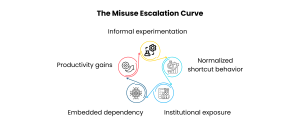
- Informal experimentation
- Productivity gains
- Normalized shortcut behavior
- Embedded dependency
- Institutional exposure
The risk grows quietly because productivity improves before consequences appear.
Why Policies Alone Fail
Many organizations create AI policies — but they are:
- Generic
- Hard to interpret
- Detached from daily workflows
- Poorly communicated
Employees don’t violate policies intentionally. They work around friction.
Effective misuse prevention requires:
- Role-specific acceptable-use guidance
- Real examples of prohibited behavior
- Ongoing scenario-based training
- Active monitoring of high-risk workflows
- Visible enforcement
Without consequences, policies are suggestions.
4. Decision Ownership: The Most Dangerous Drift
The most subtle AI risk is decision displacement.
AI is designed as a decision-support tool.
But under pressure, it becomes a decision substitute.
This shift happens gradually:
- AI drafts recommendations.
- Teams begin to trust outputs.
- Manual review becomes lighter.
- Outputs are copied directly into decisions.
- Over time, human judgment weakens.
Eventually, when something goes wrong, teams say:
“The AI recommended it.”
But AI cannot legally, ethically, or strategically own a decision.
Decision ownership must always remain human.
What True Decision Ownership Requires
- Clear documentation of the final human approver.
- Explicit override authority.
- Traceability of AI influence on outcomes.
- Review thresholds for high-impact decisions.
- Separation between recommendation and authorization.
If AI influences credit approvals, hiring decisions, medical advice, legal interpretations, or financial forecasting — the human decision-maker must be accountable and identifiable.
No AI system should ever be the final authority.
5. Incentives: The Hidden Accelerator of Risk
Incentives shape behavior more than policies.
If employees are rewarded for:
- Speed
- Efficiency
- Innovation
- Output volume
They will naturally push AI further into decision-making.
If they are not equally measured on:
- Risk compliance
- Review discipline
- Responsible usage
- Documentation standards
Misuse becomes structurally encouraged.
Organizational AI risk often reflects incentive design failures.
You cannot control AI risk without adjusting performance systems.
6. Governance Lag: The Structural Timing Problem
AI adoption spreads faster than governance evolves.
Typical timeline:
- IT pilots AI.
- Productivity improves.
- Business units adopt independently.
- Informal usage expands.
- Governance attempts to catch up.
- A public incident exposes gaps.
By the time leadership recognizes the exposure, AI is embedded in critical workflows.
Governance must be proactive, not reactive.
This requires:
- Centralized visibility into AI tools being used.
- Mandatory registration of AI-enabled workflows.
- Periodic risk reviews of high-impact use cases.
- Sunset policies for experimental deployments.
Without structured oversight, AI becomes shadow infrastructure.
7. Cultural Risk: The Over-Trust Problem
AI often produces confident, polished outputs.
This creates psychological over-trust.
Humans tend to:
- Assume technical systems are objective.
- Defer to perceived intelligence.
- Reduce critical review under time pressure.
This cognitive shift is dangerous.
Organizations must actively reinforce a culture of:
- Skepticism
- Verification
- Review discipline
- Challenge authority — even when that authority is algorithmic
Cultural safeguards are as important as technical safeguards.
8. Board-Level Implications
Boards and executive committees should not only ask:
- Are our models secure?
- Are we compliant?
- Are we protected from bias?
They should also ask:
- Which critical decisions are AI-influenced?
- Who is accountable for AI-driven outcomes?
- How do incentives affect responsible use?
- Where is AI being used informally?
- What is our escalation model for AI failures?
AI governance must move from IT discussion to boardroom oversight.
Because the risk is strategic — not just operational.
9. Building an Organizational ATC Model
To institutionalize ATC, organizations should implement:
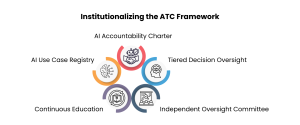
A. AI Accountability Charter
Defines:
- Executive sponsor
- Cross-functional roles
- Authority boundaries
- Risk reporting structure
B. AI Use Case Registry
Central inventory of:
- AI tools in use
- Decision impact levels
- Risk classification
- Review frequency
C. Tiered Decision Oversight
Higher-impact AI uses require:
- Dual review
- Formal documentation
- Periodic audit
D. Continuous Education
Shift from one-time policy training to:
- Scenario simulations
- Case studies
- Real incident reviews
E. Independent Oversight Committee
Reviews:
- New deployments
- Incident patterns
- Emerging risks
- Governance effectiveness
AI governance must be treated like financial governance — structured, monitored, and reviewed continuously.
10. The Strategic Reality
AI amplifies whatever already exists inside an organization.
If:
- Accountability is weak → AI magnifies confusion.
- Incentives are misaligned → AI accelerates misuse.
- Governance is fragmented → AI spreads risk.
- Culture avoids ownership → AI displaces responsibility.
But if:
- Leadership is clear,
- Oversight is disciplined,
- Incentives are aligned,
- Decision ownership is protected,
AI becomes a force multiplier for resilience.
Final Perspective
AI risk does not begin in code.
It begins in structure.
It grows in:
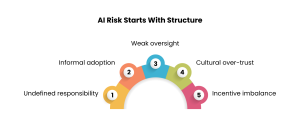
- Undefined responsibility
- Informal adoption
- Weak oversight
- Cultural over-trust
- Incentive imbalance
Technical controls are necessary.
But organizational clarity is decisive.
AI is not just a technology layer.
It is a decision infrastructure.
And decision infrastructure demands leadership discipline.
AI risk isn’t technical.
It’s organizational.
The organizations that recognize this early will design control into growth.
The rest will retrofit governance after failure.