How to Make Better Decisions in High-Speed Work Environments?
Introduction: Speed Is Winning But at What Cost?
Speed has become the currency of modern work.
Quick replies are seen as competence.
Fast execution is seen as efficiency.
Rapid decisions are seen as leadership.
But beneath this, a quieter reality exists:
Many teams are not struggling with slow decisions, they’re struggling with decisions made too quickly to be fully understood.
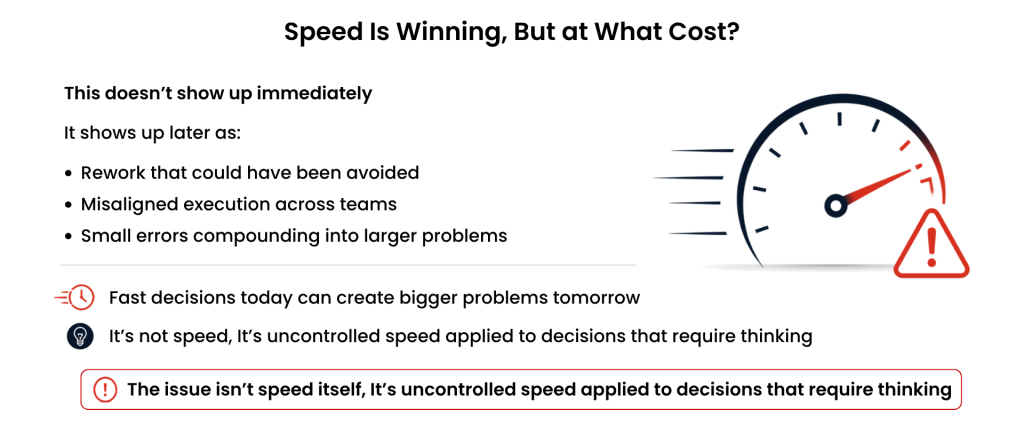
This doesn’t show up immediately.
It shows up later as:
- Rework that could have been avoided
- Misaligned execution across teams
- Small errors compounding into larger problems
The issue isn’t speed itself.
It’s uncontrolled speed applied to decisions that require thinking.
The Real Problem: When Speed Becomes the Default Setting
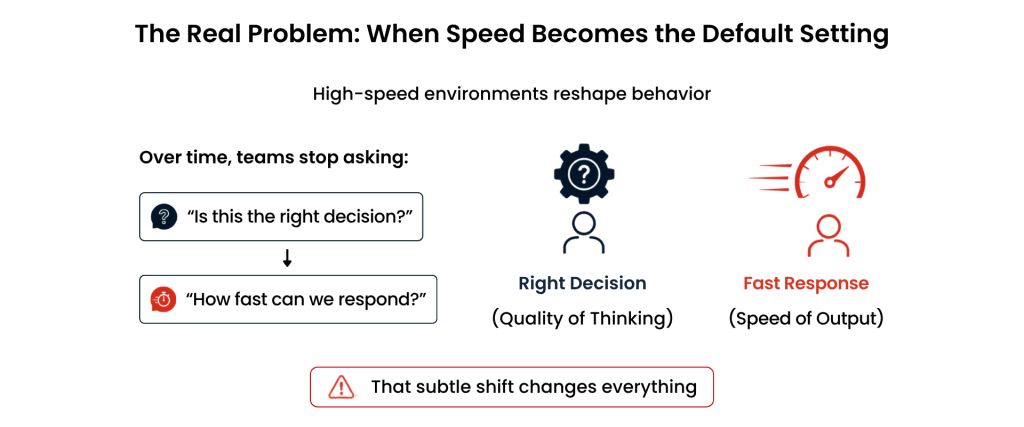
High-speed environments don’t just increase pace—they reshape behavior.
Over time, teams stop asking:
- “Is this the right decision?”
And start asking:
- “How fast can we respond?”
That subtle shift changes everything.
Because decision-making is no longer about quality of thinking, it becomes about speed of output.
Why Decision Quality Breaks Down Under Pressure?
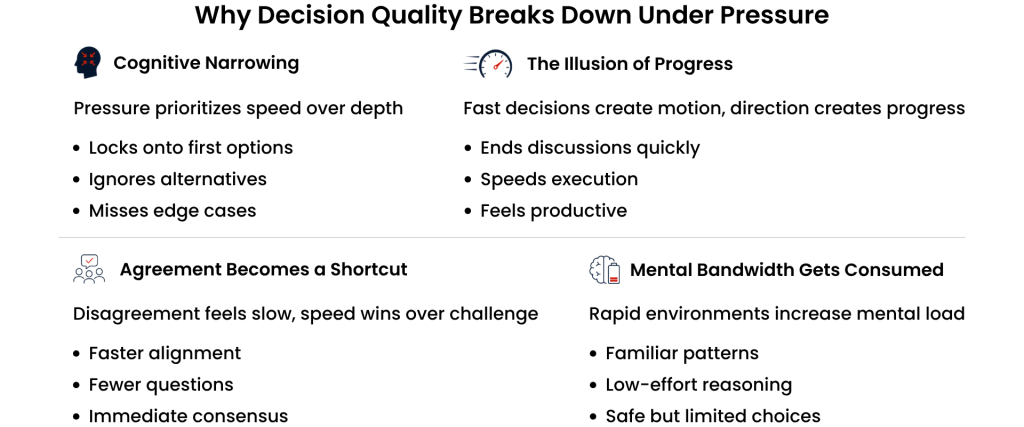
1. Cognitive Narrowing (Not Lack of Intelligence)
Under time pressure, the brain prioritizes efficiency over depth.
- It locks onto the first reasonable option
- It ignores alternative perspectives
- It stops exploring edge cases
This is not poor thinking it’s compressed thinking.
And compressed thinking leads to fragile decisions.
2. The Illusion of Progress
Fast decisions create a sense of movement.
But movement is not the same as progress.
Teams often:
- Close discussions quickly
- Move to execution faster
- Feel productive
Only to realize later that they solved the wrong problem.
3. Agreement Becomes a Shortcut
In fast environments, disagreement feels like friction.
So teams unconsciously optimize for:
- Faster alignment
- Fewer questions
- Immediate consensus
But this creates a dangerous pattern:
Decisions get validated before they get challenged.
4. Mental Bandwidth Gets Consumed
Rapid environments force constant context switching.
Each quick decision:
- Uses a small amount of mental energy
- Reduces attention span for the next decision
By the time a critical decision appears,
the brain defaults to:
- Familiar patterns
- Low-effort reasoning
- Safe but suboptimal choices
The Shift That Changes Everything
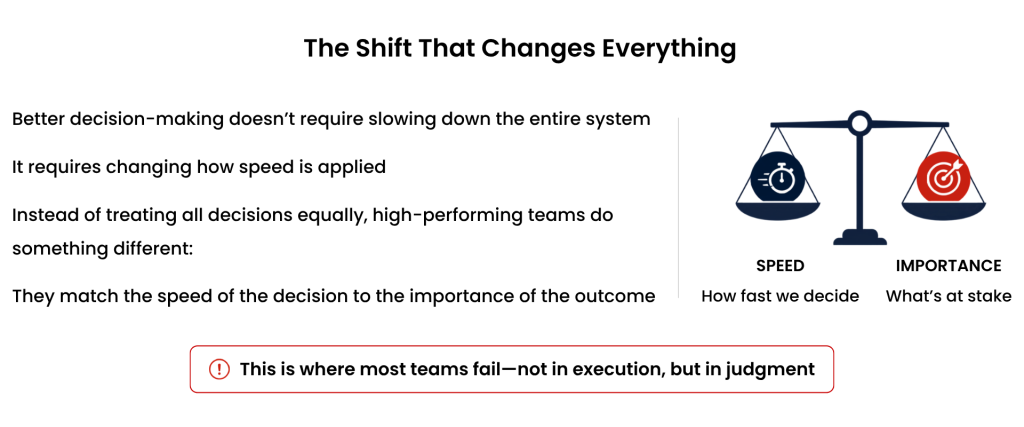
Better decision-making doesn’t require slowing down the entire system.
It requires changing how speed is applied.
Instead of treating all decisions equally,
high-performing teams do something different:
They match the speed of the decision to the importance of the outcome.
This is where most teams fail not in execution, but in judgment.
A More Advanced Decision-Making Approach
1. Decision Triage: Protect Your Thinking Where It Matters
Not every decision deserves your best thinking.
But some absolutely do.
Classify decisions into three layers:
Layer 1: High-Stakes Decisions
- Long-term impact
- Hard to reverse
- Affects multiple stakeholders
Approach:
Slow down intentionally.
Involve diverse perspectives.
Challenge assumptions.
Layer 2: Flexible Decisions
- Moderate impact
- Reversible with effort
Approach:
Decide with available information.
Stay open to iteration.
Layer 3: Operational Decisions
- Low impact
- Easily reversible
Approach:
Move fast. Avoid overthinking.
Key Insight:
Most teams don’t make bad decisions, they apply the wrong speed to the wrong decision.
2. The “Structured Pause” Technique
Pausing is often misunderstood as delay.
But in high-speed environments, the most effective professionals don’t pause randomly, they pause strategically.
Before finalizing a decision, run a quick mental checklist:
- What assumption am I relying on?
- What information would change this decision?
- What’s the second-best option—and why am I not choosing it?
This takes less than a minute but dramatically improves clarity.
3. Think in Consequences, Not Choices
Most decisions are framed as:
- “What should we do?”
Better decision-makers think differently:
- “What will this decision create?”
Project forward:
- What happens in 1 day?
- 1 week?
- 1 month?
This shifts thinking from action-focused to outcome-focused.
4. Surface Trade-Offs Early
Every fast decision hides a trade-off.
Examples:
- Speed vs. accuracy
- Convenience vs. quality
- Short-term relief vs. long-term impact
Poor decisions ignore trade-offs.
Good decisions make them explicit.
Great decisions choose trade-offs consciously.
5. Use Friction Intentionally
Most teams try to eliminate friction.
But a small amount of friction improves decisions.
Examples:
- One required “challenge question” before approval
- A quick second opinion on high-impact decisions
- A rule: “No immediate yes on complex issues”
Insight:
Removing all friction increases speed but reduces thinking.
6. Create Decision Ownership, Not Decision Dependency
In fast environments, bottlenecks kill momentum.
But over-centralizing decisions creates another problem:
shallow thinking at the edges.
Instead:
- Push decisions closer to where information exists
- Define clear ownership
- Allow autonomy within boundaries
This improves both speed and quality.
7. Turn Decisions into Feedback Systems
Most organizations treat decisions as isolated events.
But better organizations treat them as learning loops.
After key decisions, reflect:
- Was the speed appropriate?
- What did we miss?
- What would we do differently next time?
This builds decision maturity over time.
Leadership: The Invisible Force Behind Decision Quality
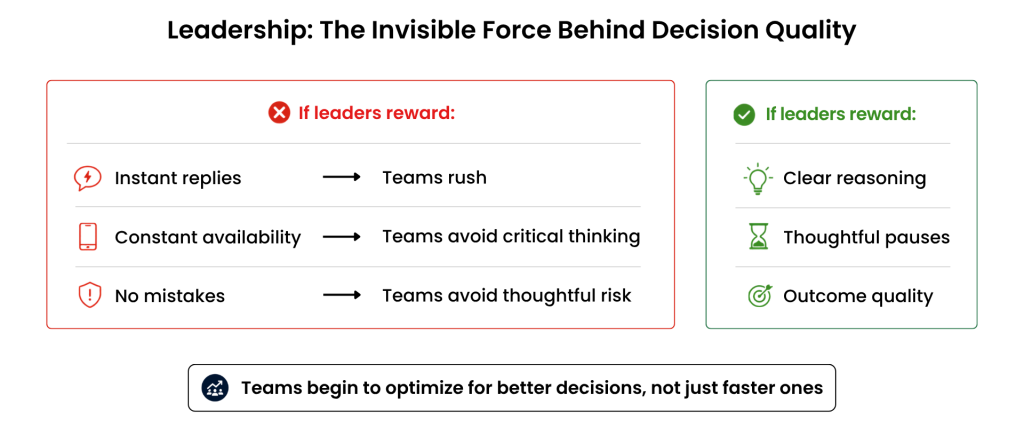
Leaders often underestimate their influence on decision-making.
Without saying it directly, they signal what matters:
If leaders reward:
- Instant replies → teams rush
- Constant availability → teams avoid independent thinking
- No mistakes → teams avoid thoughtful risk
If leaders reward:
- Clear reasoning
- Thoughtful pauses
- Outcome quality
Teams begin to optimize for better decisions not just faster ones.
A Deeper Insight: The Real Risk Isn’t Wrong Decisions
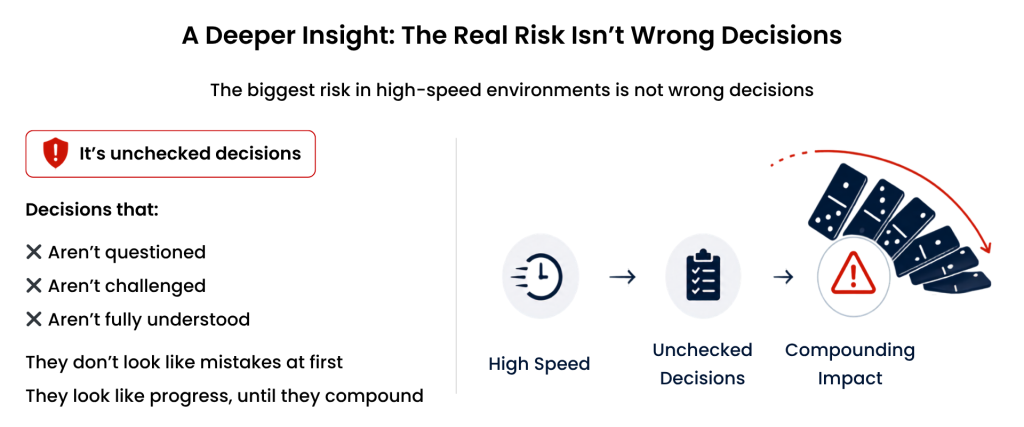
The biggest risk in high-speed environments is not wrong decisions.
It’s unchecked decisions.
Decisions that:
- Aren’t questioned
- Aren’t challenged
- Aren’t fully understood
Because these don’t feel like mistakes at first.
They feel like progress.
Until they compound.
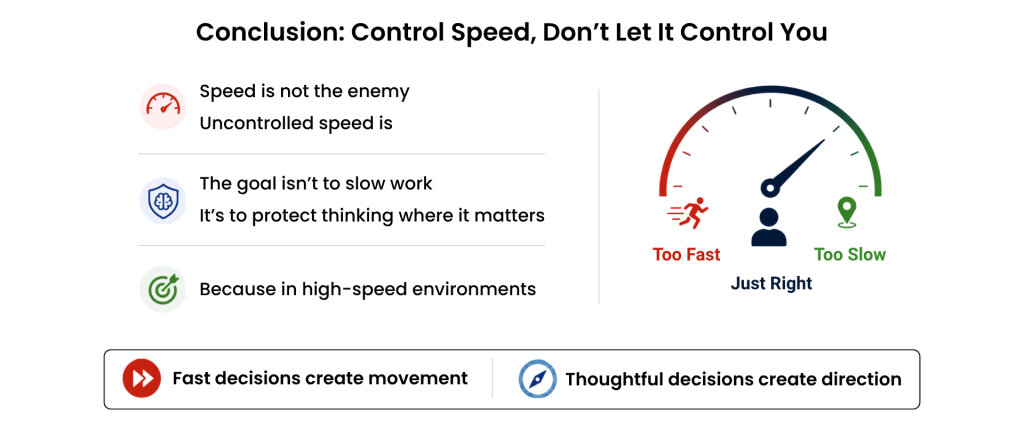
Conclusion: Control Speed Don’t Let It Control You
Speed is not the enemy.
Uncontrolled speed is.
The goal is not to slow down work.
It’s to protect thinking where it matters most.
Because in high-speed environments:
- Fast decisions create movement
- Thoughtful decisions create direction
And long-term success depends on both.
Final Thought
Anyone can move fast.
But the real advantage belongs to those who can: Stay clear, think better, and decide wisely even when everything around them is moving quickly.