Sustainability Is Not Just Environmental — It’s Personal Too
When people hear the word sustainability, they usually think about climate, energy, or environmental responsibility. But sustainability applies to people too.
In modern work culture, many professionals are operating in ways that are productive in the short term but unsustainable over time. Long hours, constant urgency, endless notifications, and pressure to always perform may create temporary results but they also consume mental energy faster than it can recover.
Personal sustainability is about creating a way of working and living that can continue without damaging focus, health, clarity, or motivation.
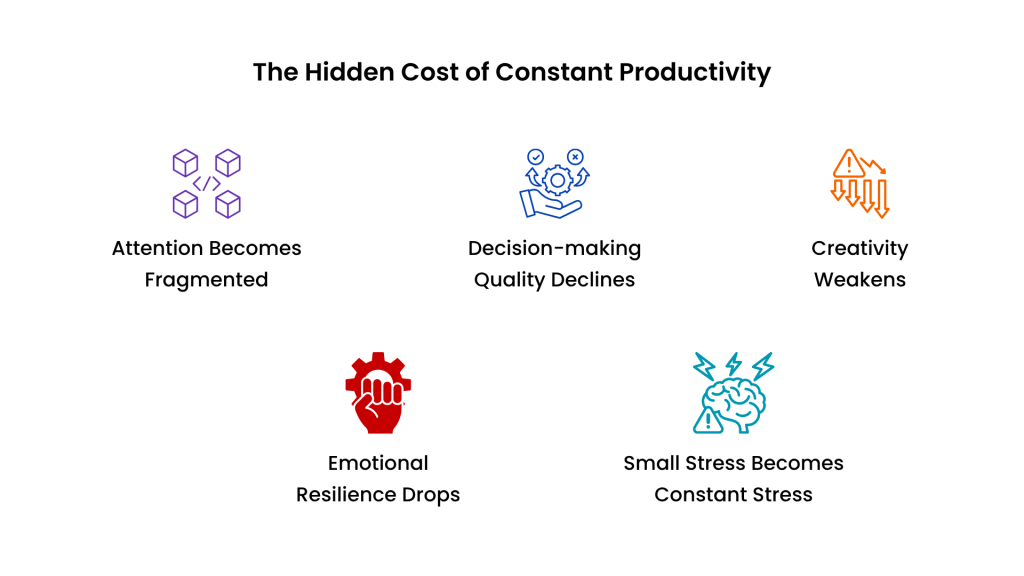
The Hidden Cost of Constant Productivity
Many people are not struggling because they lack ambition.
They are struggling because they are running at maximum intensity without recovery.
The problem with high-performance cultures is that exhaustion often looks like dedication at first.
People continue delivering.
Meetings continue happening.
Deadlines continue getting met.
But internally:
- Attention becomes fragmented
- Decision-making quality declines
- Creativity weakens
- Emotional resilience drops
- Small stress becomes constant stress
Burnout rarely happens suddenly.
It usually develops through long periods of unsustainable mental load.
Mental Energy Is a Limited Resource
Time management is important.
But mental energy management matters even more.
Two people can work the same number of hours and experience completely different levels of exhaustion depending on:
- Context switching
- Emotional stress
- Decision fatigue
- Lack of recovery
- Constant interruptions
- Unclear priorities
Sustainable performance requires protecting cognitive capacity, not just maximizing output.
Because eventually:
- Overloaded minds make slower decisions
- Reactive work replaces thoughtful work
- Urgency starts controlling priorities
- Consistency becomes harder to maintain
The issue is not effort.
The issue is recovery without guilt.
Long-Term Thinking Requires Balance
Short-term intensity can produce quick wins.
But long-term success depends on stability.
The most effective professionals are not always the busiest people in the room.
Often, they are the people who:
- Think clearly under pressure
- Maintain focus consistently
- Protect their energy intentionally
- Avoid unnecessary chaos
- Build systems instead of relying only on motivation
Sustainability is not about avoiding hard work.
It is about avoiding self-destructive patterns disguised as ambition.
Because success becomes fragile when it depends entirely on exhaustion.
The Problem With “Always On” Culture
Modern digital environments reward responsiveness:
- Fast replies
- Constant availability
- Continuous engagement
- Immediate action
But constant accessibility comes with a psychological cost.
When the brain never fully disconnects:
- Stress remains elevated
- Attention recovery weakens
- Sleep quality declines
- Deep thinking becomes difficult
Over time, this creates a cycle where people stay busy but lose clarity.
Being constantly active is not the same as being effective.
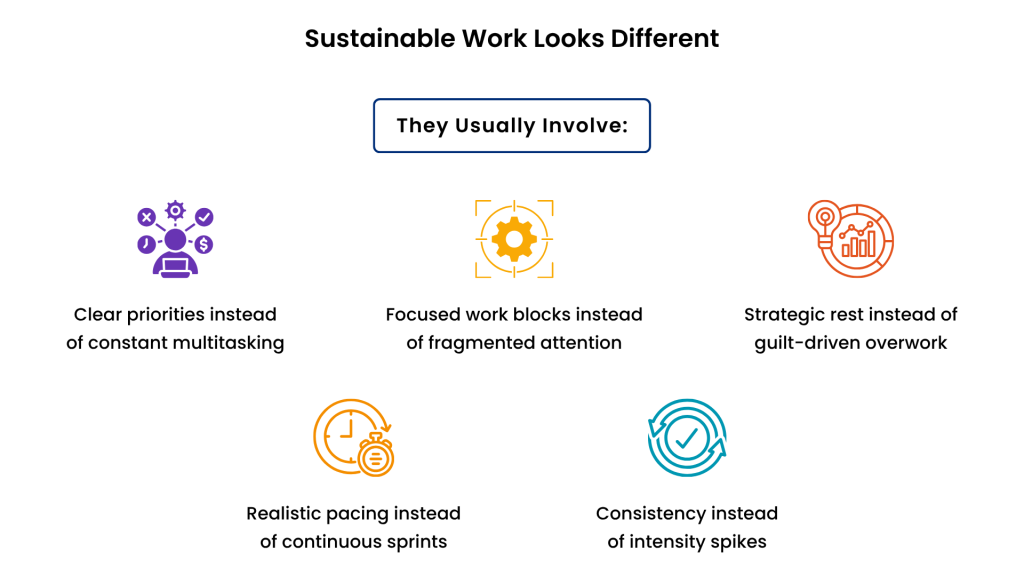
Sustainable Work Looks Different
Sustainable work habits are often less dramatic than hustle culture suggests.
They usually involve:
- Clear priorities instead of constant multitasking
- Focused work blocks instead of fragmented attention
- Strategic rest instead of guilt-driven overwork
- Realistic pacing instead of continuous sprints
- Consistency instead of intensity spikes
These habits may appear slower in the moment.
But they are more durable over years.
And durability matters.
Because sustainable systems outperform unsustainable bursts of motivation.
Balance Is Not Laziness
One of the biggest misconceptions about balance is that it reduces ambition.
In reality, balance protects performance.
Athletes understand recovery.
Machines require maintenance.
Organizations need resilience.
People are no different.
Mental sustainability allows individuals to:
- Think better
- Adapt faster
- Handle stress more effectively
- Maintain creativity longer
- Make higher-quality decisions consistently
Without balance, performance eventually becomes reactive rather than intentional.
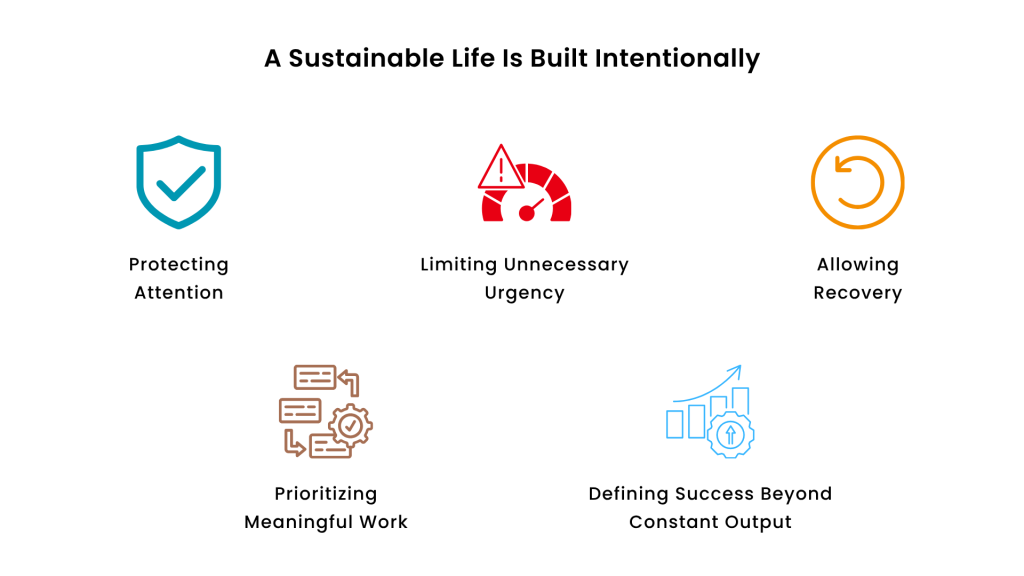
A Sustainable Life Is Built Intentionally
Personal sustainability does not happen automatically.
It requires conscious boundaries:
- Protecting attention
- Limiting unnecessary urgency
- Allowing recovery
- Prioritizing meaningful work
- Defining success beyond constant output
The goal is not to eliminate ambition.
The goal is to make ambition sustainable.
Because the healthiest form of success is not built on permanent exhaustion.
Final Thought
Sustainability is not only about protecting external environments.
It is also about protecting internal capacity.
Mental energy, focus, clarity, and emotional resilience are resources too.
And in a world that constantly pushes for more speed, more output, and more availability, personal sustainability becomes a competitive advantage.
Not because it slows people down but because it allows them to keep going without losing themselves in the process.