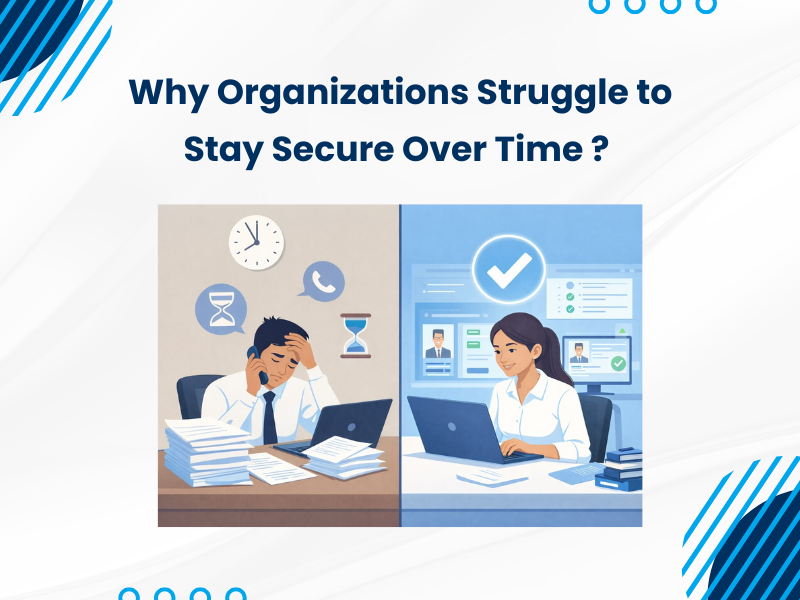
Why Organizations Struggle to Stay Secure Over Time?
Security failures rarely happen overnight. They are the result of slow, often invisible breakdowns in consistency, discipline, and focus. What makes this especially challenging is that most organizations don’t start from a place of weakness they start strong. They invest in tools, define policies, and align with standards.
Yet over time, that strength fades. Not because organizations stop caring, but because sustaining security is fundamentally harder than building it.
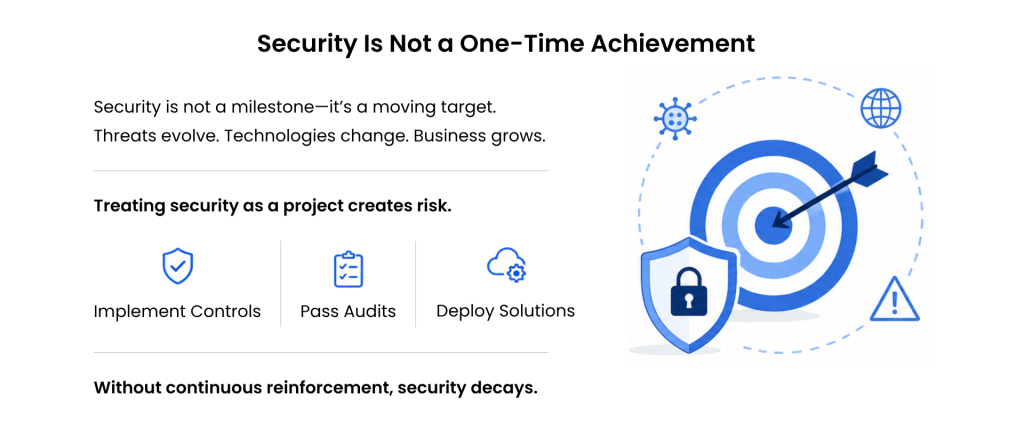
Security Is Not a One-Time Achievement
At its core, security is not a milestone it’s a moving target. Threat landscapes evolve, technologies change, and business operations expand. What worked six months ago may already be outdated today.
Despite this, many organizations treat security as a project:
- Implement controls
- Pass audits
- Deploy solutions
Once completed, attention shifts elsewhere. This creates a dangerous gap between initial implementation and ongoing execution. Security, left without continuous reinforcement, begins to decay.
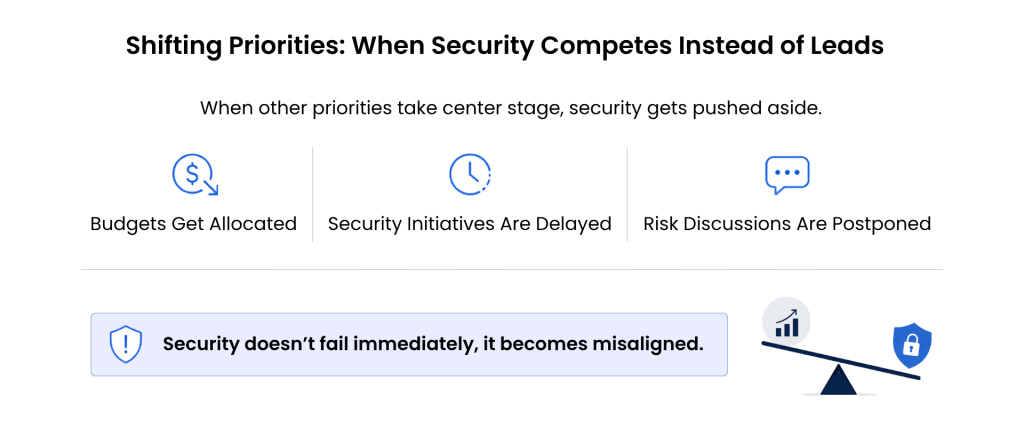
1. Shifting Priorities: When Security Competes Instead of Leads
Every organization operates in a dynamic environment. Revenue goals, innovation, customer demands, and operational efficiency often take center stage. In comparison, security is frequently seen as a supporting function rather than a business enabler.
Over time:
- Budgets get reallocated
- Security initiatives are delayed
- Risk discussions are postponed
This doesn’t mean security is ignored it means it’s no longer central.
The impact is subtle but significant. Controls that were once aligned with business risks become outdated. New systems are introduced without proper security integration. Decisions are made quickly, often without full risk visibility.
Security doesn’t fail immediately it becomes misaligned.
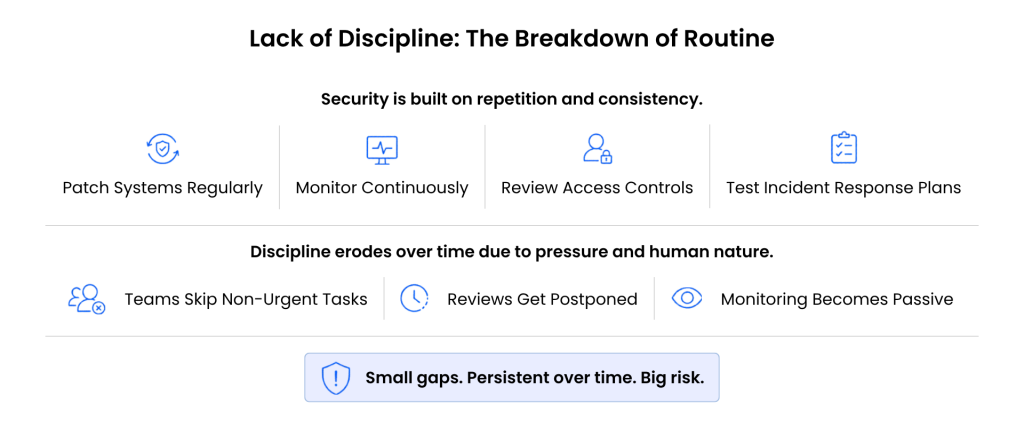
2. Lack of Discipline: The Breakdown of Routine
Security is built on repetition and consistency.
The fundamentals are well-known:
- Patch systems regularly
- Monitor continuously
- Review access controls
- Test incident response plans
These tasks are not complex but they are relentless.
The challenge is human nature and operational pressure.
Over time:
- Teams skip non-urgent tasks
- Reviews get postponed
- Monitoring becomes passive rather than active
This is where discipline erodes. And when discipline erodes, risk accumulates quietly.
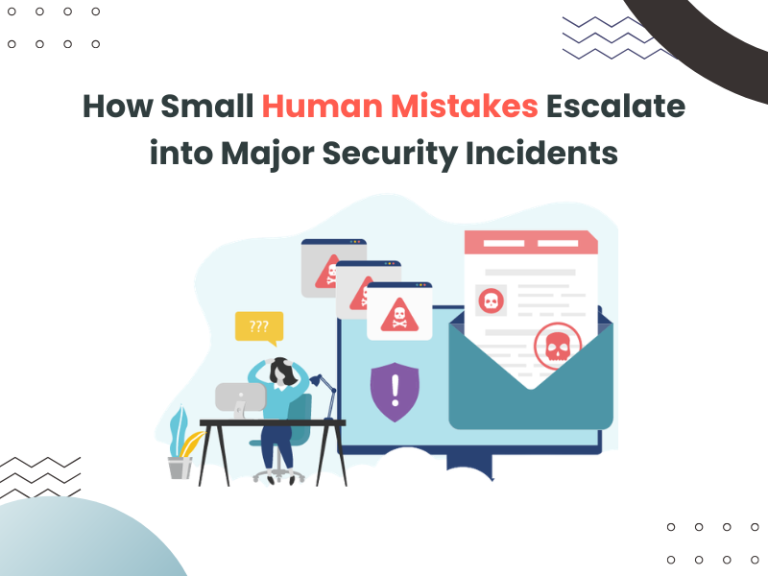
A missed patch here, an unchecked alert there these are not isolated issues. They create patterns of vulnerability. Attackers don’t need large gaps; they exploit small, persistent ones.
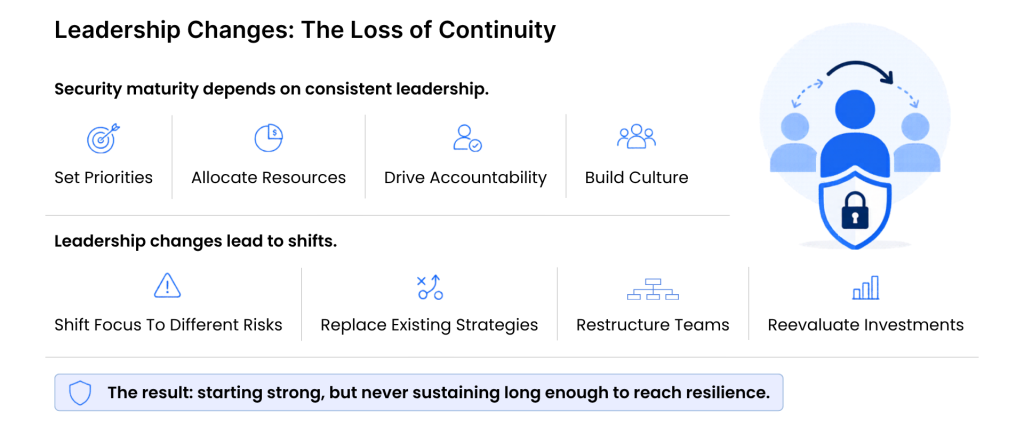
3. Leadership Changes: The Loss of Continuity
Security maturity depends heavily on consistent leadership.
Strong leaders:
- Set priorities
- Allocate resources
- Drive accountability
- Build culture
But leadership is rarely stable over long periods. When changes occur, so do perspectives.
New leaders may:
- Shift focus to different risks
- Replace existing strategies
- Restructure teams
- Reevaluate investments
While change can bring improvement, it often disrupts momentum. Long-term security initiatives require time to mature. Frequent resets prevent that maturity.
The result is a cycle of starting strong but never sustaining long enough to reach resilience.
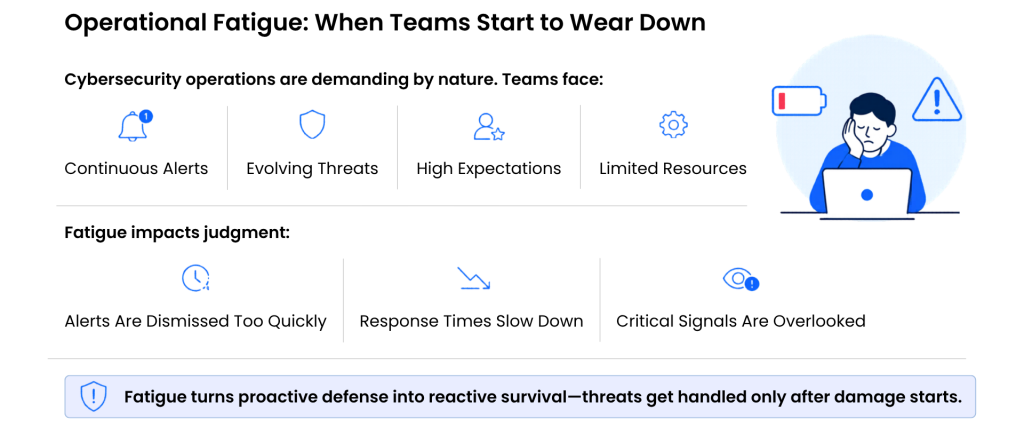
4. Operational Fatigue: When Teams Start to Wear Down
Cybersecurity operations are demanding by nature.
Teams face:
- Continuous alerts
- Evolving threats
- High expectations
- Limited resources
Over time, this leads to operational fatigue.
Fatigue doesn’t just reduce productivity it impacts judgment:
- Alerts are dismissed too quickly
- Response times slow down
- Critical signals are overlooked
Even experienced professionals are affected. When teams operate in a constant state of pressure, they shift from proactive defense to reactive survival.
This creates a dangerous environment where threats are not prevented they are only addressed after damage begins.
5. The Hidden Problem: Security Without Integration
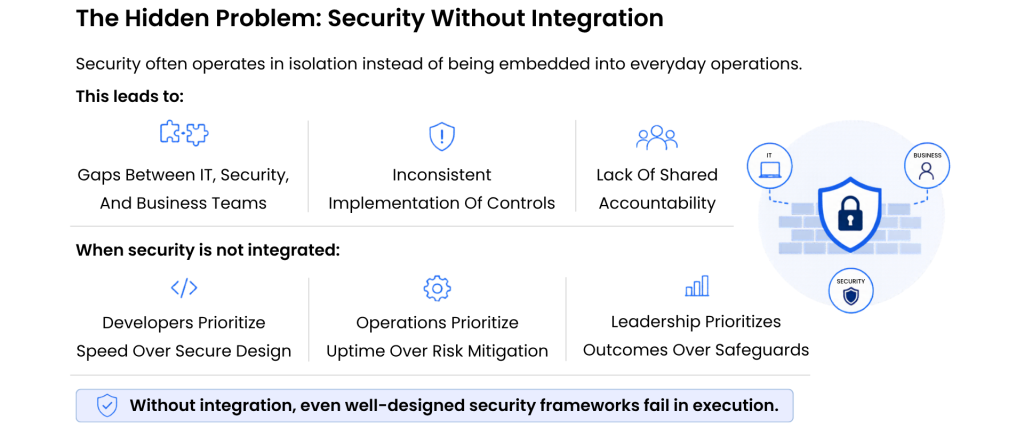
Another critical issue is that security often operates in isolation. It exists as a separate function rather than being embedded into everyday operations.
This leads to:
- Gaps between IT, security, and business teams
- Inconsistent implementation of controls
- Lack of shared accountability
When security is not integrated:
- Developers prioritize speed over secure design
- Operations prioritize uptime over risk mitigation
- Leadership prioritizes outcomes over safeguards
Without integration, even well-designed security frameworks fail in execution.
Why Sustainability Is the Real Challenge?
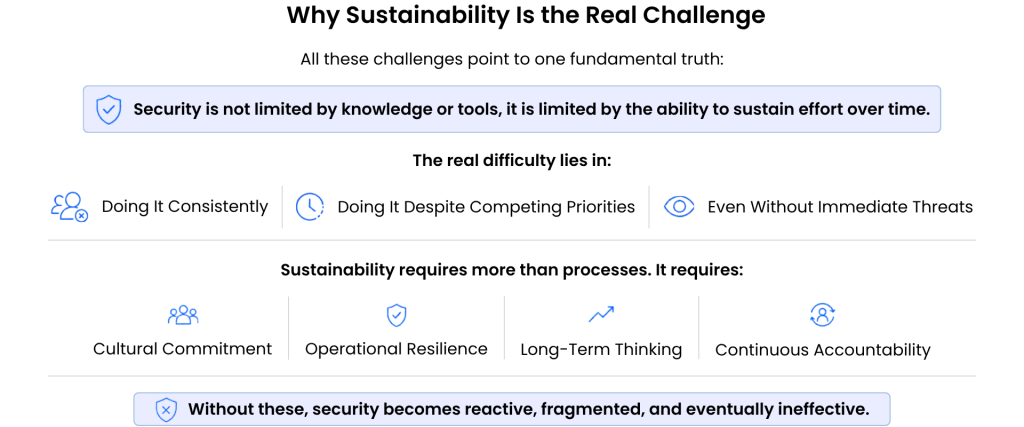
All these challenges point to one fundamental truth:
Security is not limited by knowledge or tools it is limited by the ability to sustain effort over time.
Organizations generally know what needs to be done.
The real difficulty lies in:
- Doing it consistently
- Doing it despite competing priorities
- Doing it even when there is no immediate threat
Sustainability requires more than processes. It requires:
- Cultural commitment
- Operational resilience
- Long-term thinking
- Continuous accountability
Without these, security becomes reactive, fragmented, and eventually ineffective.
From Short-Term Success to Long-Term Resilience
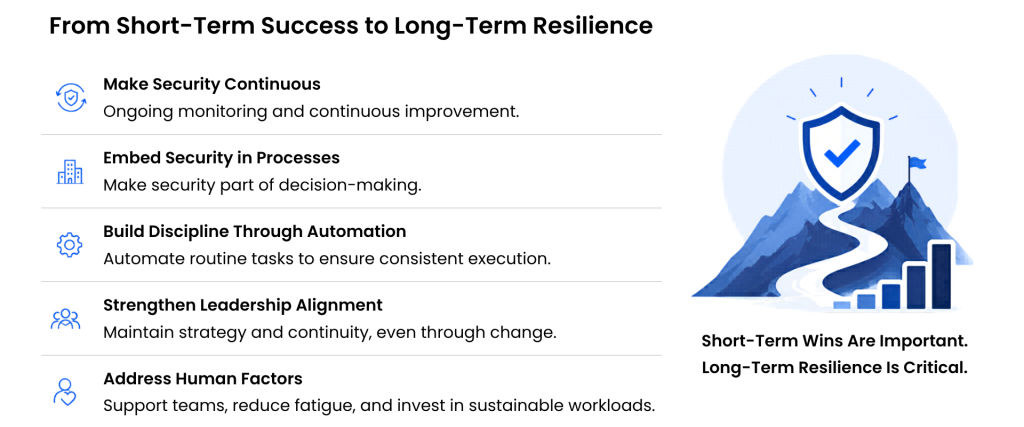
To overcome these challenges, organizations must rethink how they approach security:
1. Make Security Continuous, Not Periodic
Replace one-time assessments with ongoing monitoring and improvement.
2. Embed Security Into Business Processes
Ensure security is part of decision-making—not an afterthought.
3. Build Discipline Through Automation
Reduce reliance on manual consistency by automating routine tasks.
4. Strengthen Leadership Alignment
Ensure continuity in strategy, even when leadership changes.
5. Address Human Factors
Support teams, reduce fatigue, and invest in sustainable workloads.
Final Perspective
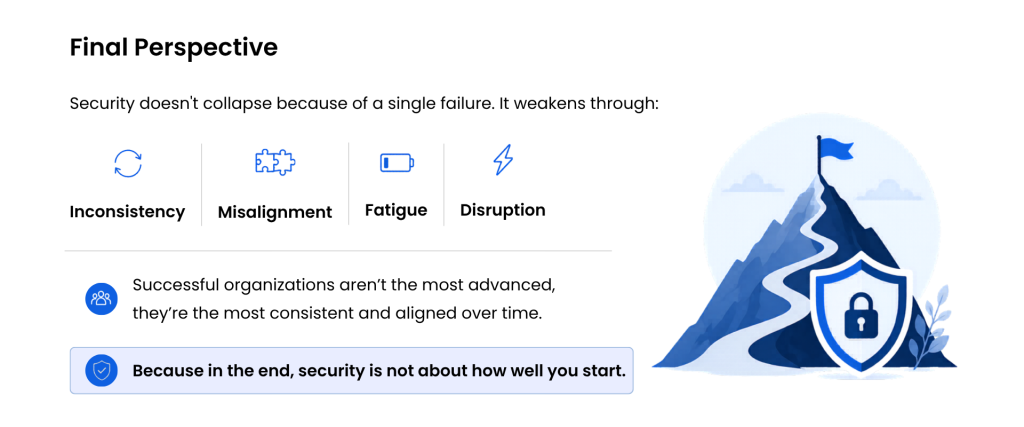
Security doesn’t collapse because of a single failure.
It weakens through:
- Inconsistency
- Misalignment
- Fatigue
- Disruption
The organizations that succeed are not the ones with the most advanced tools they are the ones that can maintain focus, discipline, and alignment over time. Because in the end, security is not about how well you start. It’s about how well you continue.