Zero Trust Is a Strategy, Not a Product Stack
For years, Zero Trust has been marketed as a destination—something you buy, deploy, and check off. Vendor roadmaps promise “Zero Trust in a box,” and organizations proudly list the tools they’ve acquired to prove maturity.
Yet despite heavy investment, breaches continue. Lateral movement still happens. Privilege creep persists. And security teams quietly admit that the environment feels more complex, not more controlled.
The uncomfortable truth is this:
Zero Trust fails when it is treated as a product stack.
It succeeds only when it is treated as a strategy.
The Core Misunderstanding: Architecture vs. Tools
At its heart, Zero Trust is an architectural philosophy, not a collection of controls.
Architecture answers questions like:
- Where does trust originate?
- How is access evaluated and re-evaluated?
- What assumptions are explicitly removed?
- How does risk flow across systems?
Tools, by contrast, answer only:
- How do we enforce a decision?
Many organizations invert this relationship. They start with tools—identity platforms, network segmentation products, endpoint agents—and attempt to assemble a strategy after deployment.
The result is a patchwork of controls without a unifying trust model.
What Architecture-First Zero Trust Looks Like
An architectural approach defines:
- Trust boundaries and trust signals
- Decision points for access
- Enforcement layers across identity, device, network, and workload
- Feedback loops for continuous verification
Only after this foundation is established do tools become meaningful. Without architecture, tools merely enforce fragmented assumptions.
Identity-First Design: The New Control Plane
Zero Trust fundamentally shifts the security perimeter—from the network to identity.
But “identity-first” does not mean “identity-only.”
Beyond Authentication
Many implementations stop at:
- MFA everywhere
- Conditional access rules
- SSO consolidation
These are necessary—but insufficient.
An identity-first Zero Trust design treats identity as:
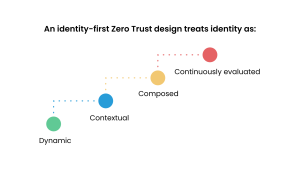
- Dynamic (risk changes over time)
- Contextual (who, what, where, why)
- Composed (human, machine, workload)
- Continuously evaluated, not statically granted
Common Identity Design Failures
- Treating service accounts as trusted forever
- Ignoring workload and API identities
- Granting broad privileges to reduce friction
- Separating identity governance from runtime access
In practice, identity becomes the largest unmonitored attack surface, not the strongest control.
What Strong Identity-First Design Requires
- Unified identity visibility across users, machines, and workloads
- Risk-based access decisions, not binary allow/deny
- Explicit ownership of non-human identities
- Tight coupling between identity posture and access enforcement
Zero Trust collapses quickly when identity is assumed to be “handled” rather than actively governed.
Governance: The Missing Layer in Most Zero Trust Programs
One of the least discussed—but most critical—elements of Zero Trust is governance.
Technology enforces decisions.
Governance determines which decisions should exist and who owns them.
Why Governance Is Often Ignored
Governance is not:
- Shiny
- Vendor-driven
- Easily diagrammed
But without it, Zero Trust becomes brittle.
Governance Questions Zero Trust Must Answer
- Who defines acceptable trust levels?
- Who approves exceptions—and for how long?
- How are policies reviewed and retired?
- How is business risk weighed against security risk?
- How do controls adapt as the organization changes?
Without governance:
- Exceptions become permanent
- Policies drift out of relevance
- Security teams become gatekeepers instead of partners
- Business units route around controls
Mature Zero Trust Governance Includes
- Clear policy ownership across security and business
- Risk-based exception management
- Regular policy review cycles
- Metrics focused on outcomes, not coverage
- Executive accountability for trust decisions
Zero Trust is not self-sustaining. It must be actively governed to remain effective.
Phased Adoption: Why “Big Bang” Zero Trust Fails
Zero Trust is often introduced as a sweeping transformation. Organizations attempt to redesign access models across the entire enterprise simultaneously.
This almost always fails.
Why Big Bang Approaches Collapse
- Legacy systems cannot adapt quickly
- Users experience abrupt friction
- Security teams are overwhelmed
- Business impact is poorly understood
- Exceptions explode
Zero Trust becomes synonymous with disruption.
The Case for Phased Adoption
Successful organizations treat Zero Trust as a multi-year journey, not a single initiative.
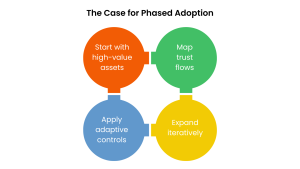
They:
- Start with high-value assets
- Crown-jewel applications
- Sensitive data stores
- Administrative access paths
- Map trust flows
- Who accesses what?
- From where?
- Under what conditions?
- Apply adaptive controls
- Stronger verification where risk is highest
- Lighter controls where risk is lower
- Expand iteratively
- Lessons learned inform the next phase
- Controls are refined, not duplicated
Phased adoption builds confidence, reduces resistance, and creates measurable wins.
Zero Trust as an Operating Model
The most mature organizations no longer describe Zero Trust as a project.
They describe it as an operating model.
This means:
- Security decisions are continuous, not event-based
- Trust is explicitly minimized and constantly challenged
- Access is aligned to business purpose
- Controls evolve as threats and workflows change
In this model:
- Tools are interchangeable
- Architecture is stable
- Governance is active
- Strategy drives technology—not the other way around
The Strategic Shift Organizations Must Make
The future of Zero Trust does not belong to those with the most tools.
It belongs to those who:
- Design trust intentionally
- Govern access rigorously
- Align controls to business reality
- Adopt incrementally and learn continuously
The defining question is no longer
“Which Zero Trust products do we have?”
It is:
“Where, why, and for how long do we allow trust to exist?”
Until organizations can answer that clearly, Zero Trust will remain a label—not a strategy.