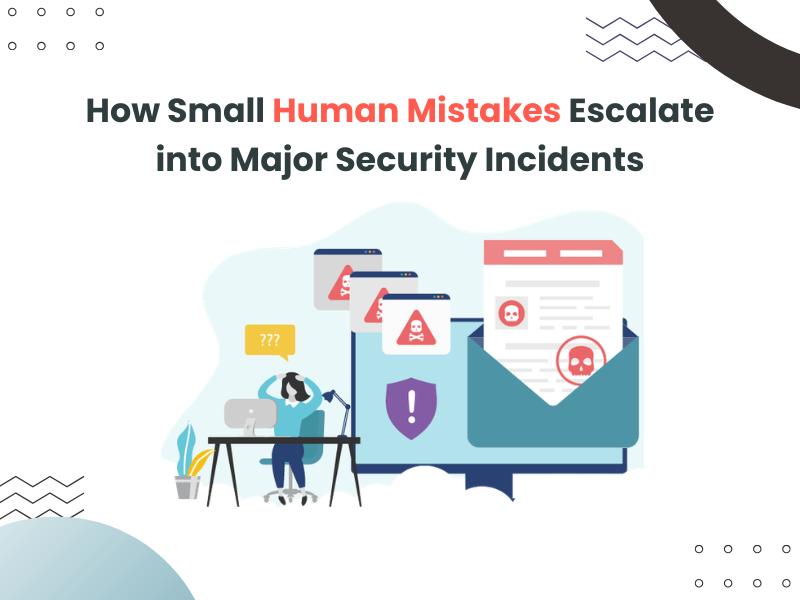
How Small Human Mistakes Escalate into Major Security Incidents?
In cybersecurity discussions, organizations often focus on advanced threats—sophisticated malware, zero-day exploits, or highly organized threat actors. While these threats are real, many major security incidents do not start with complex attacks. Instead, they begin with something much simpler: a small human mistake.
A misconfigured permission.
A forgotten patch.
A shared password.
A rushed approval.
Individually, these actions may seem minor. But within complex digital environments, small errors can quietly grow into large security failures. Understanding how this escalation happens is essential for building resilient security programs.
The Reality: Human Error Is a Leading Cause of Breaches
Technology environments are becoming more complex every year. Organizations operate across cloud platforms, on-premise infrastructure, remote work environments, and third-party integrations. In such environments, even well-trained employees can make mistakes.
Industry reports consistently show that human error contributes to a significant portion of security incidents. These errors are rarely malicious. They typically happen because of:
- Time pressure
- Lack of visibility
- Process gaps
- Miscommunication between teams
- Overly complex systems
The problem is not simply that mistakes happen. The real risk is how those mistakes interact with systems that lack safeguards.
How Small Mistakes Turn into Major Security Incidents?
Security incidents often follow a pattern. A small action introduces a weakness, and over time that weakness expands until it becomes an exploitable vulnerability.
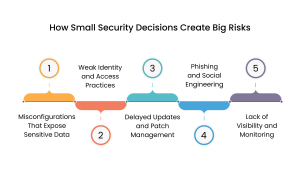
1. Misconfigurations That Expose Sensitive Data
A common starting point is a simple configuration mistake.
Examples include:
- A cloud storage bucket accidentally made public
- Overly permissive access rights granted to users
- Firewall rules that allow unnecessary external access
- Temporary permissions that are never revoked
At the time the change is made, the risk may not be obvious. However, attackers actively scan the internet for such weaknesses. A single misconfiguration can expose sensitive data to anyone who knows where to look.
2. Weak Identity and Access Practices
Another frequent trigger is improper identity management.
Small decisions can introduce significant risk:
- Sharing credentials between team members
- Granting administrative access for convenience
- Failing to remove access when employees change roles
- Skipping multi-factor authentication for internal systems
These shortcuts often happen during urgent operational situations. Unfortunately, they create entry points that attackers can exploit later.
Once attackers gain valid credentials, security systems may treat them as legitimate users, allowing them to move through the environment undetected.
3. Delayed Updates and Patch Management
Software vulnerabilities are discovered every day. Vendors release patches to fix them, but applying those updates takes time and coordination.
A small operational decision—delaying a patch for a few days or weeks—can create a window of opportunity for attackers.
Common reasons patches are delayed include:
- Fear of breaking production systems
- Lack of testing environments
- Limited maintenance windows
- Resource constraints
When attackers discover unpatched systems, they often automate exploitation. What started as a scheduling decision can quickly become a security breach.
4. Phishing and Social Engineering
Human judgment plays a critical role in defending against phishing attacks. Even a well-designed security system can fail if a user unknowingly grants access.
A typical scenario might look like this:
- An employee receives a convincing email that appears legitimate.
- The employee clicks a link and enters credentials.
- Attackers capture the login information.
- The attackers access internal systems.
- Data exfiltration or lateral movement begins.
The initial mistake may take only seconds, but the consequences can unfold over weeks or months.
5. Lack of Visibility and Monitoring
Small mistakes become dangerous when organizations cannot detect them early.
If security teams lack visibility into:
- Access patterns
- Configuration changes
- Privileged activity
- Data movement
then early warning signs go unnoticed.
Many major breaches are discovered months after the initial compromise. During that time, attackers may quietly explore systems, escalate privileges, and extract sensitive information.
The Role of Complexity
Modern IT environments contain hundreds or even thousands of interconnected systems. Each platform introduces its own configurations, permissions, and operational processes.
Complexity increases the likelihood of human error in several ways:
- Teams must manage too many tools
- Security policies vary across systems
- Responsibility for controls becomes unclear
- Documentation becomes outdated
In such environments, even skilled professionals can make mistakes simply because the system is difficult to manage consistently.
Why These Incidents Often Escalate?
Small errors become major incidents when three conditions exist:
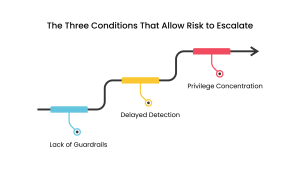
1. Lack of Guardrails
If systems allow risky configurations without warning or validation, mistakes pass through unnoticed.
2. Delayed Detection
Without continuous monitoring, weaknesses remain exposed for long periods.
3. Privilege Concentration
When accounts have excessive permissions, attackers can cause greater damage after gaining access.
When these factors combine, a minor operational oversight can evolve into a full-scale security breach.
What Mature Security Programs Do Differently?
Organizations that reduce human-error risks typically shift their approach from reactive security to structural prevention.
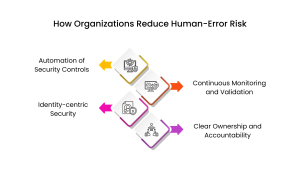
Key practices include:
Automation of Security Controls
Automated policies can prevent risky configurations before they occur. For example:
- Blocking public cloud storage exposure
- Enforcing least-privilege access
- Automatically expiring temporary permissions
Automation reduces the reliance on manual judgment.
Continuous Monitoring and Validation
Instead of assuming controls remain effective, mature programs continuously validate them.
This includes:
- Monitoring configuration drift
- Reviewing privileged access
- Detecting unusual login behavior
- Verifying security control performance
Continuous validation helps catch mistakes early.
Identity-Centric Security
Modern security strategies increasingly focus on identity as the primary control layer.
This approach includes:
- Multi-factor authentication
- Just-in-time privileged access
- Role-based access management
- Regular access reviews
By limiting what each identity can do, organizations reduce the potential damage from compromised accounts.
Clear Ownership and Accountability
Security controls often fail when responsibility is unclear.
Successful programs define:
- Who owns each security control
- Who validates it
- How exceptions are approved
- When access must expire
Clear accountability ensures that controls remain active and effective.
Building a Culture That Reduces Human Error
Technology alone cannot eliminate human mistakes. However, organizations can create environments where errors are less likely and easier to detect.
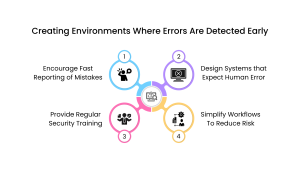
Important cultural practices include:
- Encouraging employees to report mistakes quickly
- Designing systems that assume human error will occur
- Providing regular security awareness training
- Simplifying workflows wherever possible
When employees feel safe reporting issues early, small problems are resolved before they escalate.
Conclusion
Major security incidents rarely begin with dramatic events. More often, they start with small, routine decisions made during everyday operations.
A misconfigured setting.
A rushed approval.
A delayed update.
In complex environments, these seemingly minor actions can interact with systemic weaknesses and grow into serious security failures.
The goal of modern security programs is not to eliminate human error entirely—that is impossible. Instead, the objective is to build systems that anticipate mistakes, detect them quickly, and limit their impact.
Organizations that design their security architecture with this mindset are far better positioned to prevent small errors from becoming major crises.