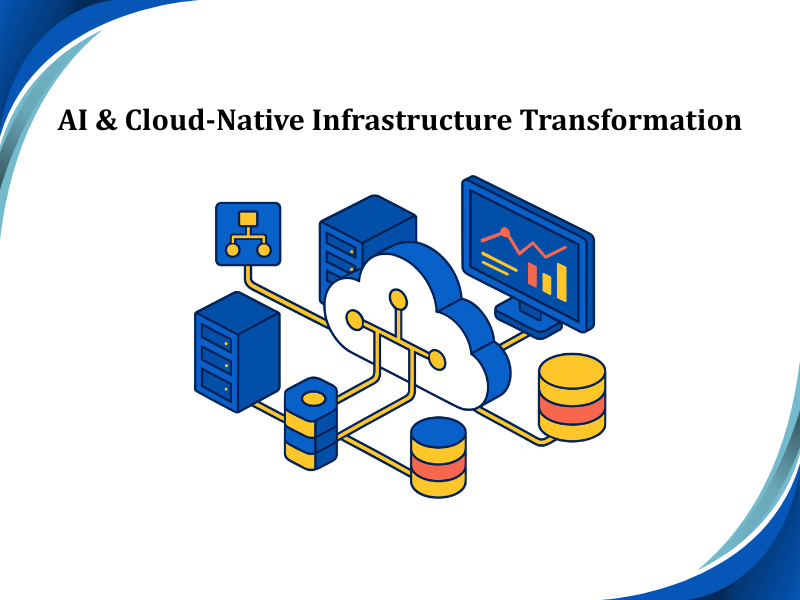
AI & Cloud-Native Infrastructure Transformation: A Deep Dive into the Future of Enterprise IT
In today’s rapidly evolving digital landscape, AI and Cloud-Native Infrastructure have emerged as the most powerful forces reshaping how organizations build, scale, secure, and deliver modern applications. Together, they are not just transforming technology stacks—they are redefining business models, innovation velocity, operational efficiency, and competitive advantage.
This blog takes a deep, detailed, and word-to-word look into how AI and cloud-native architectures are driving a complete transformation across the enterprise ecosystem.
- Introduction: The Era of Intelligent, Cloud-Native Enterprises
The convergence of Artificial Intelligence (AI) and Cloud-Native Infrastructure is creating a new paradigm where organizations can operate smarter, faster, and more securely. Traditional monolithic architectures, manual processes, and siloed systems are no longer sufficient for modern business demands. Enterprises require:
- elastic scalability
- automated decision-making
- resilient architectures
- continuous delivery
- real-time insights
- cost-optimized operations
Cloud-native principles and AI capabilities complement each other, forming the foundation for intelligent digital transformation.
- What Is Cloud-Native Infrastructure?
Cloud-native infrastructure is designed to fully leverage the scalability, flexibility, and resilience of cloud environments. It emphasizes:
- Microservices Architecture: Applications broken into independent, manageable services.
- Containers & Kubernetes: Portable, lightweight execution environments for consistent deployments.
- DevOps & CI/CD: Automated pipelines for continuous integration and rapid releases.
- Infrastructure as Code (IaC): Declarative configuration and automated provisioning.
- Service Mesh: Advanced traffic control, security, and resilience for microservices.
- Observability & Telemetry: End-to-end visibility with logs, metrics, and traces.
This infrastructure enables teams to deploy faster, recover quicker, and innovate continuously.
- AI: The Intelligence Layer Powering Modern Cloud Ecosystems
Artificial Intelligence enhances cloud-native environments by introducing automation, predictive analytics, and intelligent insights. Key AI capabilities include:
- Predictive operations (AIOps)
- Automated resource optimization
- Intelligent monitoring and anomaly detection
- AI-powered security analysis
- Natural language interfaces (chatbots, assistants)
- Generative AI for development, automation, and documentation
- Machine learning pipelines for data-driven decision making
AI is no longer an add-on—it is deeply embedded into modern cloud platforms and workflows.
- How AI and Cloud-Native Architecture Work Together
When combined, AI and cloud-native infrastructure unlock exponential value:
4.1 Autonomous Infrastructure Management
AI-driven automation can analyze performance patterns, predict failures, and automatically adjust resources. Kubernetes autoscaling + AI insights = self-healing, self-optimizing systems.
4.2 Accelerated Software Delivery
AI-powered DevOps (AIOps + MLOps) enhances:
- code generation
- automated testing
- performance tuning
- pipeline optimization
- deployment accuracy
This reduces time-to-market dramatically.
4.3 Enhanced Security and Cloud Governance
AI strengthens cloud-native security with:
- continuous threat monitoring
- behavioral analytics
- anomaly detection
- automated risk mitigation
Cloud Guard, SIEMs, and AI-based identity security create a proactive defense posture.
4.4 Intelligent Application Architectures
AI is embedded directly into microservices, APIs, and business workflows. This helps organizations deliver:
- personalized user experiences
- intelligent automation
- real-time decisioning
- hyper-scalable digital platforms
- Business Benefits of AI-Enabled Cloud-Native Transformation
Enterprises experience significant value across every dimension:
5.1 Improved Operational Efficiency
AI automates maintenance, troubleshooting, scaling, and optimization—reducing human intervention and OPEX costs.
5.2 Faster Innovation and Delivery
CI/CD pipelines enhanced with AI enable rapid prototyping, agile releases, and faster market adaptation.
5.3 Higher Resilience and Reliability
Cloud-native patterns like container orchestration, service mesh, and AI-driven remediation increase system uptime.
5.4 Data-Driven Decision Making
AI models process real-time cloud telemetry, business transactions, and customer behavior to support smarter decisions.
5.5 Cost Optimization
AI monitors cloud usage patterns and recommends or automates cost-saving measures such as:
- right-sizing
- auto-scaling
- shutting down idle resources
- optimizing workloads
- Key Components of Cloud-Native + AI Transformation
A modern enterprise transformation framework typically includes:
6.1 AI-Driven Infrastructure Automation (AIOps)
Automates detection, insights, and remediation across networks, apps, and cloud infrastructure.
6.2 Containers, Kubernetes, and Serverless
The foundation for scalable and flexible application hosting.
6.3 DevOps, GitOps & MLOps Integration
Unified operational workflows that support rapid changes and ML lifecycle management.
6.4 Data Engineering & AI Pipelines
ETL, data lakes, features stores, and model deployment pipelines.
6.5 Cloud Security & Zero Trust
AI-enhanced Zero Trust frameworks protect APIs, identities, workloads, and data.
6.6 Observability and Telemetry with AI Insights
AI enhances logs, metrics, and traces correlation for root cause analysis and performance tuning.
- 7. Industry Use Cases
7.1 Financial Services
- AI fraud detection
- real-time risk scoring
- cloud-native trading platforms
- automated compliance
7.2 Healthcare
- predictive diagnostics
- secure patient data exchange
- cloud-native health apps
- automated insurance workflows
7.3 Retail & E-commerce
- personalized recommendations
- inventory automation
- AI-driven customer analytics
7.4 Manufacturing
- predictive maintenance
- supply chain optimization
- IoT + AI cloud analytics
7.5 Government & Public Sector
- smart governance
- digital identity
- AI-driven citizen services
- Challenges in AI & Cloud-Native Transformation
While the benefits are immense, organizations face:
- legacy system complexity
- talent shortages
- governance and compliance concerns
- integration challenges
- growing cost of cloud mismanagement
However, with the right strategy and expertise, these challenges can be effectively managed.
- Strategic Roadmap for AI & Cloud-Native Modernization
Step 1: Assess Current Infrastructure
Evaluate workloads, dependencies, and performance gaps.
Step 2: Build a Cloud-Native Foundation
Adopt microservices, containers, IaC, observability, and DevOps.
Step 3: Integrate AI Across Workflows
Implement AIOps, MLOps, intelligent automation, and analytics.
Step 4: Transform Applications
Refactor, re-platform, or rebuild applications for cloud-native environments.
Step 5: Enable Continuous Optimization
Leverage AI for real-time tuning, security, and lifecycle management.
10. Real-World Use Cases Across Industries
10.1 Finance
- AI risk scoring
- fraud detection
- automated loan processing
- cloud-native trading systems
10.2 Healthcare
- AI diagnostics
- secure patient data management
- telemedicine platforms
10.3 Retail
- personalized recommendations
- inventory optimization
- automated supply chain
10.4 Manufacturing
- predictive maintenance
- AI-powered robotics
- smart factory automation
10.5 Public Sector
- digital governance
- automated citizen services
- real-time analytics for public safety
- A Strategic Roadmap for Enterprises
Step 1: Assess
Evaluate current infrastructure, workloads, and modernization readiness.
Step 2: Plan
Define cloud-native architecture, AI initiatives, and governance frameworks.
Step 3: Modernize
Refactor or re-platform applications using containers, microservices, and APIs.
Step 4: Automate
Introduce DevOps, IaC, security automation, and AI-based optimization.
Step 5: Operationalize AI
Deploy AIOps, MLOps, and intelligent business analytics.
Step 6: Optimize Continuously
Use AI insights for performance tuning, cost control, and ongoing improvements.
- Conclusion: The Future Is Intelligent, Autonomous, and Cloud-Native
AI and Cloud-Native Infrastructure are not just technological trends—they are the blueprint for the future of enterprise IT. Organizations that embrace this transformation unlock:
- higher agility
- greater scalability
- stronger security
- intelligent automation
- continuous innovation