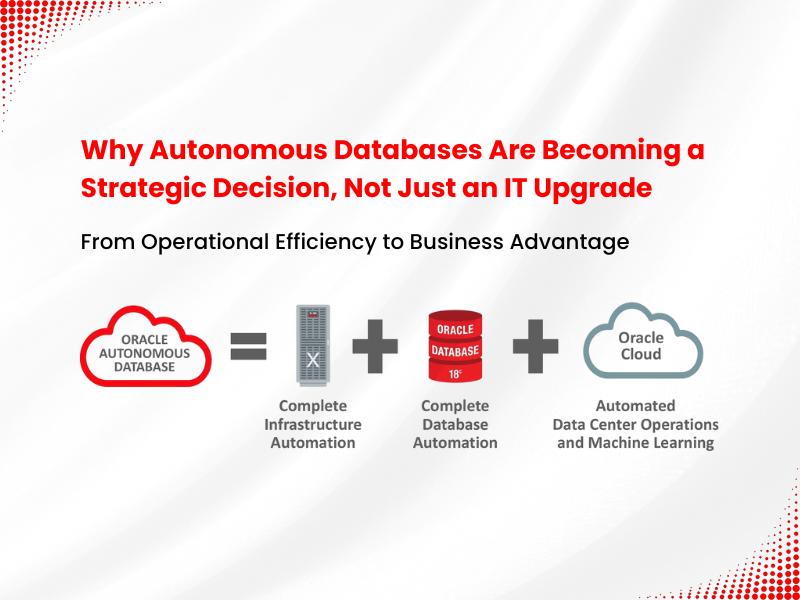
Why Autonomous Databases Are Becoming a Strategic Decision — Not Just an IT Upgrade
In today’s data-driven world, organizations face an ever-growing need to store, analyze, and act on massive volumes of data. Traditional database management systems — managed manually by DBAs and IT teams — have reached a tipping point. The complexity, cost, and risk associated with these systems have made decision-makers rethink how data platforms should be deployed and operated.
Enter autonomous databases: systems capable of self-driving operations such as tuning, patching, scaling, and securing, with minimal human intervention. Once seen as a technical upgrade or experimental technology, autonomous databases are rapidly becoming a strategic imperative across industries.
In this blog, we explore why — focusing on cost optimization, enhanced security, operational automation, and reduced human error, along with broader business benefits.
1. The Shift from IT Upgrade to Strategic Asset
From Manual to Autonomous
Traditional databases require constant human oversight — database administrators (DBAs) must tune performance, apply patches, monitor for failures, and provision resources. As systems scale, this manual approach becomes costly and unsustainable.
Autonomous databases automate these tasks using built-in machine learning and AI, turning what was once an operations task into a strategic capability.
Strategic Value Over Technical Upgrade
What differentiates autonomous databases from a simple IT update is their ability to:
- Free up human capital
- Accelerate time-to-value for analytics and applications
- Support innovation initiatives at scale
- Align IT more directly with business outcomes
Organizations no longer see them as “nice to have” — they’re becoming central to digital transformation efforts.
2. Cost: Optimizing Spend While Increasing Value
A. Lower Total Cost of Ownership
Autonomous databases reduce the need for large DBA teams. Routine tasks such as performance tuning, indexing, capacity planning, and patching are automated. This can significantly lower labor costs and reduce dependency on highly specialized (and often expensive) talent.
Moreover, autoscaling means resources are only consumed when needed — helping organizations avoid over-provisioning.
B. Predictable, Usage-Based Pricing
Cloud autonomous databases often operate on a pay-as-you-go model:
- You pay for compute and storage consumed
- You don’t pay for idle times
This flexibility aligns database spend with business activity, improving budget predictability.
C. Reduced Opportunity Cost
By automating routine tasks:
- IT teams can focus on innovation rather than maintenance
- Organizations can launch new products faster
- Data insights are delivered sooner
These intangible savings add up, particularly in competitive markets where speed matters.
3. Security: A Built-In Differentiator
Security is no longer negotiable — especially as cyberthreats evolve rapidly. Autonomous databases integrate robust security directly into their core.
A. Continuous, Automated Patch Management
Human lag in applying security patches creates vulnerability windows. Autonomous systems eliminate this gap by:
- Applying critical security patches in real time
- Rebooting automatically without downtime
- Protecting data even in multi-tenant cloud environments
B. Advanced Threat Detection
Autonomous systems use machine learning to observe patterns and flag anomalies. This means:
- Suspicious access is detected faster
- Compliance reporting is more consistent
- Security teams get proactive alerts
With data breaches costing millions in fines and reputation damage, this enhanced security posture is a strategic advantage.
4. Automation: Redefining Operational Efficiency

A. Self-Tuning Performance
Traditional databases rely on human expertise to:
- Monitor slow queries
- Adjust indexing
- Diagnose performance bottlenecks
Autonomous databases use AI to:
- Analyze workload patterns
- Automatically optimize performance
- Reallocate resources on-the-fly
The result? A database that learns and adapts without manual intervention.
B. Self-Scaling Infrastructure
As workloads fluctuate — especially in retail, banking, or IoT scenarios — autonomous systems:
- Scale up during peak demand
- Scale down during lull periods
- Avoid performance bottlenecks
This capability not only optimizes cost but also enhances end-user experience.
C. Automated Backup & Recovery
Traditional backup processes:
- Require scheduling
- Need manual verification
- Risk inconsistency
Autonomous systems ensure:
- Consistent backups without human oversight
- Automated recovery workflows
- Faster restoration in case of failure
5. Reduced Human Error — A Business Risk Mitigator
Human errors in database management can have huge consequences — from system outages to data corruption and security breaches.
A. Elimination of Manual Tasks
By automating repetitive processes:
- The risk of misconfiguration drops
- Injection of human oversight errors reduces dramatically
- Consistency and repeatability increase
In highly regulated industries (healthcare, finance, government), this consistency translates directly into compliance confidence.
B. Predictive Failure Detection
Autonomous systems don’t just react — they anticipate.
Using AI, these systems can:
- Predict disk failures
- Anticipate capacity saturation
- Alert teams before critical issues emerge
This pre-emptive insight further reduces catastrophic failures tied to human oversight.
6. Business Outcomes Beyond IT
Autonomous databases deliver value far beyond technical efficiency.
A. Better Decision-Making with Faster Analytics
- Real-time data processing
- Faster access to insights
- Simplified analytics pipelines
These capabilities empower business leaders with faster, more reliable intelligence.
B. Accelerated Innovation
Freed from routine tasks, IT teams can:
- Build better customer experiences
- Integrate AI/ML workflows
- Support digital transformation initiatives
Autonomous databases become a platform for innovation, not just maintenance.
C. Competitive Advantage
Organizations that adopt autonomous systems can:
- Respond faster to market changes
- Reduce operational friction
- Scale strategically without fear of database limitations
In crowded markets, speed and agility are key differentiators.
7. Challenges and Considerations
While compelling, autonomous databases aren’t a silver bullet.

A. Migration Complexity
Migrating legacy systems can be:
- Time-consuming
- Risky
- Costly without proper planning
B. Skill Shifts
IT teams must transition from:
- Hands-on administration
to - Strategic data governance, architecture, and analytics expertise
C. Vendor Lock-In
Some autonomous solutions are tied to specific cloud ecosystems — requiring thoughtful evaluation before adoption.
However, these challenges are largely transitional and far outweighed by long-term benefits.
Conclusion
Autonomous databases are no longer a futuristic concept — they are a strategic imperative.
What started as an IT efficiency project has evolved into a core pillar of modern digital infrastructure. By reducing cost, strengthening security, automating operations, and eliminating human error, autonomous databases allow organizations to shift their focus from maintaining systems to driving business value.
Whether a global enterprise optimizing costs at scale or a startup aiming for rapid innovation, autonomous databases are reshaping how data powers business in the digital age.
