Vendor Lock-In as a Strategic Risk, Not Just a Procurement Issue
As organizations accelerate digital transformation, reliance on external technology providers has grown significantly. Cloud platforms, enterprise software, security tools, analytics platforms, and managed services now form the backbone of many business operations. While these vendor ecosystems deliver efficiency and innovation, they also introduce a risk that is often underestimated: vendor lock-in.
In many companies, vendor lock-in is still treated as a procurement concern — a matter of negotiating contracts, controlling licensing costs, or managing vendor relationships. However, the reality is far more complex. Vendor lock-in can influence an organization’s strategic flexibility, operational resilience, innovation capacity, and long-term financial stability.
For this reason, vendor lock-in should be recognized not simply as a purchasing issue, but as a strategic risk that requires enterprise-level oversight.
Understanding Vendor Lock-In
Vendor lock-in occurs when an organization becomes dependent on a particular technology provider in ways that make switching to an alternative provider difficult, expensive, or operationally disruptive.
This dependency can arise through several mechanisms:
- Proprietary Technologies
Many vendors offer proprietary platforms, frameworks, and services that are optimized to work within their own ecosystems. While these technologies may offer strong performance and integration, they often lack compatibility with external systems. - Data Dependency
Data stored in vendor-specific formats or deeply embedded within proprietary platforms can become difficult to extract or migrate. Data migration challenges are one of the most significant contributors to lock-in. - Integration Complexity
Over time, organizations integrate vendor platforms with numerous internal systems, third-party applications, and operational processes. These integrations create technical dependencies that complicate transitions. - Operational Familiarity
Teams develop expertise and workflows around a specific platform. Training investments and operational processes become tailored to that vendor’s environment. - Financial Commitments
Long-term contracts, enterprise licensing models, and bundled services can further reinforce dependency.
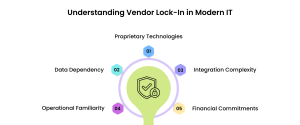
Individually, these factors may seem manageable. However, when they accumulate over time, they create a situation where switching vendors becomes highly disruptive.
Why Vendor Lock-In Is a Strategic Risk?
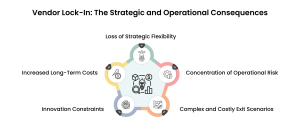
- Loss of Strategic Flexibility
Modern organizations must constantly adapt to changes in technology, markets, and regulatory environments. Strategic flexibility is essential.
Vendor lock-in can limit the ability to:
- adopt new platforms
- integrate emerging technologies
- pursue hybrid or multi-cloud strategies
- respond quickly to changing business requirements
If core systems are tightly coupled with a single vendor’s ecosystem, strategic decisions become constrained by the capabilities and limitations of that vendor.
In effect, the technology vendor begins to influence the organization’s future direction.
- Increased Long-Term Costs
During vendor selection, pricing may appear competitive and attractive. However, once systems are deeply integrated into a vendor ecosystem, switching costs rise dramatically.
This creates asymmetric negotiation power.
Vendors may introduce:
- incremental licensing increases
- new feature pricing tiers
- mandatory upgrades
- service bundling
Organizations that are deeply locked in may have limited leverage to negotiate pricing or explore alternatives.
Over time, operational costs can increase significantly compared to more flexible technology environments.
- Concentration of Operational Risk
Vendor concentration can also create operational vulnerabilities.
If a major vendor experiences:
- security breaches
- service outages
- supply chain disruptions
- regulatory or compliance issues
organizations heavily dependent on that vendor may experience cascading operational impact.
For example, a critical cloud platform outage can disrupt:
- applications
- data access
- authentication systems
- internal business processes
- customer-facing services
From a risk management perspective, heavy dependency on a single provider contradicts the principle of risk diversification.
- Innovation Constraints
Vendor ecosystems evolve according to the vendor’s own product roadmap, not necessarily according to each customer’s strategic priorities.
When organizations rely heavily on a vendor platform, they may find themselves dependent on the vendor for:
- feature development
- performance improvements
- compatibility updates
- integration capabilities
If innovation slows or strategic direction changes at the vendor level, customers may struggle to maintain their own pace of digital transformation.
In this scenario, organizations are waiting for innovation rather than driving it.
- Complex and Costly Exit Scenarios
The most significant challenge of vendor lock-in often emerges when organizations attempt to exit the relationship.
Migration can involve:
- data extraction and transformation
- application redesign
- system reconfiguration
- infrastructure migration
- user retraining
- contract termination penalties
These processes can take months or even years to complete.
In many cases, organizations continue using suboptimal platforms simply because the cost and disruption of switching are too high.
Why Vendor Lock-In Is Not Just a Procurement Issue?
Procurement teams play a vital role in vendor management, but vendor lock-in typically develops after the procurement phase, during implementation and operational use.
Procurement typically focuses on:
- vendor selection
- contract negotiation
- pricing agreements
- service-level commitments
However, lock-in is often driven by decisions made in other areas such as:
- software architecture
- cloud infrastructure design
- development frameworks
- integration strategies
- data management practices
Without collaboration between procurement, IT, security, and enterprise architecture teams, the organization may unintentionally create deep dependencies on vendor-specific capabilities.
This is why vendor lock-in must be addressed through enterprise governance rather than contract negotiation alone.
Early Warning Signs of Vendor Lock-In
Organizations can identify growing lock-in risk by monitoring several indicators:
- Extensive reliance on proprietary APIs
- Data stored in vendor-controlled formats
- Applications tightly coupled to vendor-specific services
- Limited internal expertise outside one platform ecosystem
- Infrastructure designed exclusively for one cloud environment
- Increasing migration complexity
If these patterns persist without mitigation, vendor dependency can become deeply embedded within the organization’s technology landscape.
Strategies to Reduce Vendor Lock-In Risk
While eliminating vendor dependency entirely is rarely practical, organizations can take steps to maintain flexibility and reduce risk.
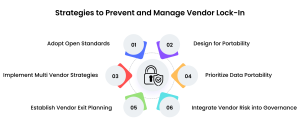
- Adopt Open Standards
Using open standards helps ensure interoperability between systems and reduces reliance on proprietary technologies.
Standards-based architectures support easier migration and integration.
- Design for Portability
Applications and workloads should be designed with portability in mind.
Technologies such as containerization and platform abstraction can make it easier to move workloads between environments when necessary.
- Implement Multi-Vendor Strategies
Critical capabilities should not always rely on a single provider. Diversifying across vendors can reduce operational risk and improve negotiating leverage.
Multi-vendor environments also encourage interoperability and resilience.
- Prioritize Data Portability
Data should remain accessible in standardized formats whenever possible.
Organizations should ensure they maintain:
- data export capabilities
- migration procedures
- independent backups
Control of data is central to maintaining vendor independence.
- Establish Vendor Exit Planning
Organizations should define potential exit strategies early in the vendor lifecycle.
Planning for exit does not mean planning to leave — it ensures the organization retains strategic choice.
Exit planning should include:
- migration feasibility assessments
- contractual exit clauses
- operational transition plans
- Integrate Vendor Risk into Governance
Vendor dependency should be regularly reviewed within:
- enterprise architecture reviews
- risk management frameworks
- technology strategy discussions
- digital transformation planning
By embedding vendor risk into governance processes, organizations can prevent dependency from growing unnoticed.
Executive Perspective: Strategic Technology Independence
At the leadership level, vendor lock-in should be viewed through the lens of strategic independence.
Technology decisions made today can shape organizational flexibility for years or even decades.
Executives must balance the benefits of vendor ecosystems — such as speed, integration, and innovation — against the long-term risks of dependency.
Organizations that manage vendor lock-in effectively are better positioned to:
- adapt to technological change
- maintain negotiating leverage
- respond to disruptions
- sustain innovation
Those that ignore it may discover that their strategic options have quietly narrowed over time.
Final Insight
Vendor partnerships are essential in modern technology environments. No organization can build every capability internally.
The objective is not to avoid vendors — it is to avoid irreversible dependence.
When vendor lock-in is treated only as a procurement concern, organizations overlook its broader implications.
When it is recognized as a strategic risk, organizations can design technology ecosystems that remain flexible, resilient, and aligned with long-term business goals.