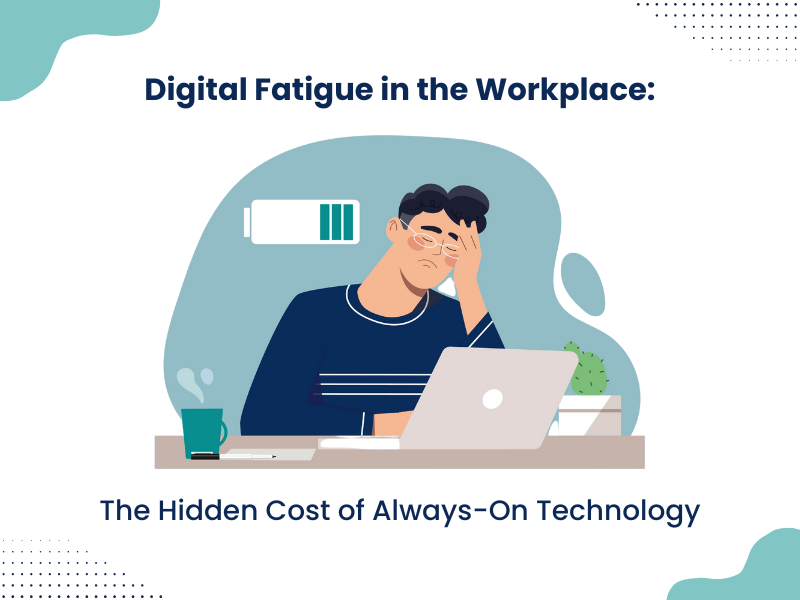
Digital Fatigue in the Workplace: The Hidden Cost of Always-On Technology
Digital transformation has fundamentally changed how work gets done. Emails, instant messages, collaboration platforms, dashboards, and video calls have enabled speed, scale, and flexibility that were unimaginable just a generation ago. Yet beneath these gains lies a growing and often overlooked challenge: digital fatigue.
Digital fatigue is the cumulative mental, emotional, and cognitive strain caused by constant interaction with digital tools and the expectation of continuous availability. It does not appear overnight, nor is it always visible. Instead, it builds quietly—affecting wellbeing, decision quality, productivity, and ultimately organizational performance.
This blog explores digital fatigue as a systemic workplace issue, examining its impact on burnout, errors, productivity, and the critical role leadership plays in addressing the hidden cost of always-on technology.
The Rise of the Always-On Workplace
Modern workplaces are defined by connectivity. Workflows are no longer linear or confined to business hours. Global teams collaborate across time zones, messages travel instantly, and updates happen in real time. While this connectivity enables agility, it has also normalized uninterrupted access to employees.
Availability has gradually become an unspoken job requirement. Many employees feel pressure to respond quickly, remain visible online, and monitor multiple communication channels throughout the day—and often beyond it. The boundary between work and personal life has thinned, not through policy, but through expectation.
The always-on workplace is not inherently harmful. The problem arises when connectivity is unmanaged, priorities are unclear, and recovery time is treated as optional rather than essential.
Burnout: When Connectivity Becomes Exhaustion
Burnout is one of the clearest consequences of sustained digital fatigue. Defined by emotional exhaustion, disengagement, and reduced effectiveness, burnout develops gradually and is often misattributed to individual resilience rather than systemic design.
How digital fatigue drives burnout:
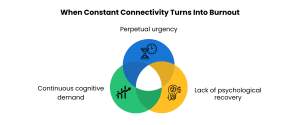
Continuous cognitive demand
Digital work requires constant attention switching—emails, chats, meetings, documents, and notifications compete simultaneously. This persistent cognitive load drains mental energy far faster than focused, sequential work.
Lack of psychological recovery
True recovery requires mental detachment from work. When employees check messages during evenings, weekends, or breaks, the nervous system remains in a state of alert, preventing restoration.
Perpetual urgency
Always-on tools create the impression that everything is time-sensitive. When urgency becomes constant, stress becomes chronic.
Burnout linked to digital fatigue often affects high performers most—those who are responsive, conscientious, and deeply committed. Over time, motivation erodes, creativity declines, and engagement gives way to survival mode.
Errors and Risk: The Cognitive Cost of Digital Overload
Digital fatigue has direct implications for accuracy, judgment, and risk. As mental resources become depleted, the brain’s ability to process information deteriorates.
Common outcomes include:
- Reduced attention to detail
- Slower reaction times
- Impaired judgment and decision-making
- Increased reliance on shortcuts and assumptions
In knowledge-intensive and high-stakes environments—such as finance, healthcare, engineering, government, and technology—these effects can translate into operational failures, compliance breaches, safety incidents, and reputational damage.
Paradoxically, organizations often respond to mistakes by adding more systems, reports, alerts, and oversight layers. While well-intentioned, this frequently increases digital load and amplifies the very fatigue that caused the errors in the first place.
Productivity: When More Technology Delivers Less Impact
Digital tools are designed to increase efficiency, yet many organizations find that productivity plateaus—or even declines—despite increased activity.
The productivity paradox of digital fatigue:
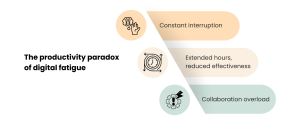
Constant interruption
Frequent notifications and meetings fragment attention, making deep, focused work difficult. Employees spend more time switching tasks than completing them.
Extended hours, reduced effectiveness
Longer online hours do not equate to better output. Fatigued employees may appear busy while producing work of lower quality and strategic value.
Collaboration overload
Multiple communication platforms, duplicated updates, and meeting-heavy cultures create friction rather than flow.
The result is an illusion of productivity: high responsiveness, visible activity, and full calendars—paired with slower progress, diminished innovation, and growing frustration.
Leadership Responsibility: A Systemic Issue, Not an Individual One
Digital fatigue is often framed as a personal time-management or resilience problem. In reality, it is shaped by organizational norms, incentives, and leadership behavior.
Leaders play a defining role in either reinforcing or reducing digital fatigue. When senior teams model constant availability, send late-night messages, or reward speed over substance, these behaviors become embedded across the organization.
Leadership actions that matter:
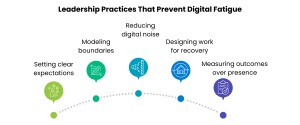
Setting clear expectations
Define what truly requires immediate response and what does not. Normalize asynchronous communication where possible.
Modeling boundaries
When leaders visibly protect focus time, take breaks, and disconnect, it legitimizes healthy behavior for others.
Reducing digital noise
Regularly evaluate tools, meetings, and reporting requirements. Eliminate duplication and low-value activity.
Designing work for recovery
Build realistic timelines, meeting-free blocks, and recovery periods after high-intensity work.
Measuring outcomes over presence
Shift performance evaluation away from online visibility and responsiveness toward quality, impact, and results.
Addressing digital fatigue requires leadership accountability. Without it, wellness initiatives risk becoming symbolic rather than structural.
Building a Sustainable Digital Work Environment
Technology will continue to shape the future of work. The question is not whether organizations will be digital, but whether they will be intentional.
Organizations that actively manage digital fatigue benefit from:
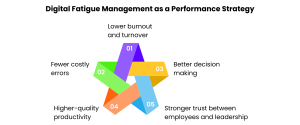
- Lower burnout and turnover
- Fewer costly errors
- Better decision-making
- Higher-quality productivity
- Stronger trust between employees and leadership
Sustainable performance does not come from being always on. It comes from designing work that balances connectivity with focus, urgency with recovery, and speed with thoughtfulness.
In an increasingly digital world, the real competitive advantage lies in knowing not just how to connect—but when to disconnect.