The Operational Cost of Running Too Many Technology Initiatives Simultaneously
Introduction: The Illusion of Productivity
In modern organizations, launching multiple technology initiatives is often seen as a sign of ambition, innovation, and forward momentum. Leadership teams push for rapid transformation, digital acceleration, and continuous improvement—all at once.
But beneath this surface-level activity lies a hidden operational cost.
When too many initiatives run simultaneously, organizations don’t move faster—they fragment. What appears as progress often becomes a complex web of competing priorities, strained resources, and weakened governance. The result is not acceleration, but inefficiency disguised as effort.
This blog explores the true operational cost through four critical dimensions: change fatigue, initiative overlap, resource dilution, and reduced control effectiveness.
1. Change Fatigue: When Transformation Becomes Exhaustion
The Hidden Human Cost
Every technology initiative introduces change—new systems, processes, tools, or behaviors. While individual initiatives may be manageable, running many at once overwhelms employees.
Teams are expected to:
- Learn multiple tools simultaneously
- Adapt to evolving workflows
- Balance delivery with continuous change
Over time, this leads to change fatigue—a state where employees become disengaged, resistant, or simply exhausted.
Operational Impact
- Declining productivity despite increased activity
- Lower adoption rates of new systems
- Increased errors due to cognitive overload
- Resistance to future initiatives
Key Insight
Change capacity is finite. When organizations exceed it, transformation slows—not because of poor strategy, but because of human limitations.
2. Initiative Overlap: When Efforts Collide
The Problem of Redundancy
Without strong coordination, multiple initiatives often target similar problems from different angles. Different teams may:
- Implement overlapping tools
- Build duplicate capabilities
- Solve the same problem in incompatible ways
This creates initiative overlap, where efforts compete instead of complementing each other.
Operational Impact
- Duplicate investments in technology and effort
- Integration challenges between parallel solutions
- Confusion over ownership and accountability
- Inconsistent user experiences across systems
Example Pattern
One team implements a workflow automation tool, while another introduces a separate platform with similar capabilities. Instead of synergy, the organization ends up managing both.
Key Insight
Overlap is not just inefficiency—it is structural misalignment. It increases complexity while reducing overall effectiveness.
3. Resource Dilution: Spreading Teams Too Thin
The Scarcity of Focus
Technology initiatives rely on shared resources:
- Skilled engineers
- Architects
- Project managers
- Business stakeholders
When too many initiatives run in parallel, these resources are spread thin across projects.
Operational Impact
- Reduced quality of delivery
- Slower progress across all initiatives
- Increased context switching (which reduces efficiency)
- Burnout among high-demand roles
The Productivity Paradox
More initiatives do not equal more output. In fact, dividing attention often leads to less progress overall, as teams struggle to maintain momentum on any single initiative.
Key Insight
Focus drives execution. Without it, even well-funded initiatives fail to deliver meaningful outcomes.
4. Reduced Control Effectiveness: When Governance Breaks Down
The Limits of Oversight
Governance structures—architecture reviews, risk assessments, compliance checks—are designed to ensure control and alignment.
But when initiative volume increases:
- Review processes become rushed
- Decision-making becomes reactive
- Standards are inconsistently applied
Operational Impact
- Increased operational risk
- Poor architectural decisions
- Security and compliance gaps
- Difficulty tracking initiative performance
The Control Illusion
Organizations often believe they are maintaining control because governance processes exist. In reality, those processes become overloaded and ineffective under excessive demand.
Key Insight
Control is not just about having frameworks—it’s about having the capacity to enforce them consistently.
The Compounding Effect: When Problems Reinforce Each Other
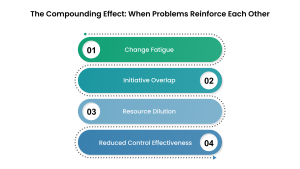
These four challenges do not exist in isolation. They amplify each other:
- Change fatigue reduces adoption, leading to rework
- Initiative overlap increases complexity, worsening fatigue
- Resource dilution slows delivery, prolonging change cycles
- Reduced control effectiveness allows inefficiencies to persist
The result is a compounding cycle where:
More initiatives create more complexity, and more complexity demands even more effort to manage.
The Real Cost: Complexity Overhead
The true operational cost is not just financial—it is complexity overhead.
This includes:
- Time spent coordinating between initiatives
- Effort required to resolve conflicts and dependencies
- Increased management layers to maintain alignment
- Ongoing maintenance of redundant or overlapping systems
Over time, this overhead consumes a significant portion of organizational capacity, leaving less room for actual innovation.
Breaking the Cycle: Designing for Focus and Control
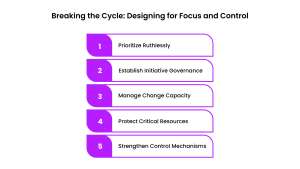
1. Prioritize Ruthlessly
Not all initiatives are equal. Organizations must:
- Limit the number of concurrent initiatives
- Focus on high-impact, strategically aligned efforts
- Delay or eliminate lower-priority work
2. Establish Initiative Governance
Create a centralized view of all initiatives to:
- Identify overlaps early
- Align objectives across teams
- Ensure clear ownership
3. Manage Change Capacity
Treat change as a limited resource:
- Sequence initiatives instead of stacking them
- Allow time for adoption and stabilization
- Measure organizational readiness before launching new efforts
4. Protect Critical Resources
Allocate key roles strategically:
- Avoid overloading high-skill individuals
- Maintain dedicated teams for critical initiatives
- Reduce context switching wherever possible
5. Strengthen Control Mechanisms
Ensure governance scales with initiative volume:
- Standardize decision frameworks
- Automate compliance checks where possible
- Maintain consistent architectural oversight
Conclusion: Progress Requires Discipline, Not Volume
Running many technology initiatives simultaneously may signal ambition, but it often undermines execution. The operational cost—manifested through fatigue, overlap, dilution, and weakened control—quietly erodes the value those initiatives aim to create.
Sustainable performance is not about doing more at once.
It is about doing the right things, at the right time, with clarity and control.
In technology strategy, success is not measured by the number of initiatives launched—but by the outcomes successfully delivered.