Green IT Isn’t Just About Energy Savings — It’s About Risk, Compliance, and Trust
For years, Green IT was narrowly defined as reducing power consumption, lowering cooling costs, or shrinking data center footprints. While these benefits remain important, they no longer capture the full picture.
Today, Green IT sits at the intersection of enterprise risk management, regulatory compliance, and stakeholder trust. Organizations that continue to view it as a “cost-saving” or “CSR” initiative are missing its strategic importance—and exposing themselves to operational, regulatory, and reputational risks.
In an era of ESG reporting mandates, climate disclosures, and increasing scrutiny of digital operations, how IT infrastructure is designed, operated, and governed now matters as much as how efficient it is.
From Efficiency Initiative to Enterprise Risk Topic
Digital infrastructure is now one of the largest and fastest-growing contributors to organizational carbon footprints. Cloud platforms, data centers, AI workloads, and always-on digital services have fundamentally changed the risk profile of IT.
Green IT has evolved because:
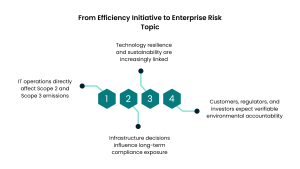
- IT operations directly affect Scope 2 and Scope 3 emissions
- Infrastructure decisions influence long-term compliance exposure
- Technology resilience and sustainability are increasingly linked
- Customers, regulators, and investors expect verifiable environmental accountability
As a result, Green IT is no longer optional—or isolated from governance discussions.
Sustainable Infrastructure: Designing for Long-Term Resilience
Sustainable infrastructure is not just about consuming less energy; it’s about building IT environments that are resilient, adaptable, and future-proof.
1. Smarter Infrastructure Architecture
Modern Green IT focuses on:
- Cloud-native architectures that optimize resource utilization
- Virtualization and containerization to reduce idle capacity
- Right-sizing compute, storage, and network resources
- Designing for scalability without linear energy growth
Poorly architected infrastructure creates:
- Hidden energy waste
- Operational inefficiencies
- Higher failure rates under stress
- Increased environmental and financial risk over time
Sustainability, when built into architecture decisions, becomes a risk-reduction mechanism rather than an afterthought.
2. Lifecycle Management as a Sustainability Control
Green IT extends across the full technology lifecycle:
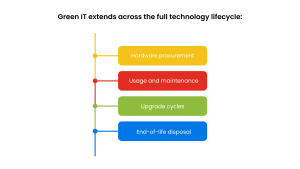
- Hardware procurement
- Usage and maintenance
- Upgrade cycles
- End-of-life disposal
Lack of lifecycle governance leads to:
- Premature asset replacement
- Untracked e-waste
- Vendor dependency risks
- Compliance exposure in regulated markets
Organizations that embed sustainability into lifecycle management reduce both environmental impact and operational uncertainty.
Compliance: Green IT as a Regulatory Readiness Requirement
Regulators are increasingly connecting technology operations with sustainability disclosures and governance expectations.
1. ESG and Climate Reporting Obligations
Many organizations now face requirements to:
- Report emissions linked to IT infrastructure
- Demonstrate controls over sustainability data
- Prove consistency between operational reality and public disclosures
Without Green IT governance:
- Sustainability data becomes fragmented
- Manual reporting introduces errors
- Audit trails are incomplete or unreliable
- Regulatory risk increases significantly
Green IT enables defensible, auditable sustainability reporting, reducing compliance risk.
2. Alignment with Industry and Government Standards
Green IT practices often intersect with:
- Data center efficiency standards
- Cloud provider sustainability commitments
- National climate and energy regulations
- Sector-specific ESG frameworks
Organizations that proactively align IT operations with sustainability standards are better positioned to:
- Respond to regulatory changes
- Pass audits with confidence
- Avoid last-minute compliance remediation
In this context, Green IT is no longer about “doing good”—it’s about being prepared.
Risk Reduction: The Hidden Value of Green IT
One of the most overlooked aspects of Green IT is its role in reducing enterprise risk.
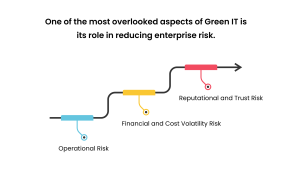 1. Operational Risk
Inefficient infrastructure:
- Runs hotter
- Fails more frequently
- Requires reactive maintenance
- Consumes unpredictable resources
Sustainable IT environments:
- Are more stable and predictable
- Reduce unplanned downtime
- Support better capacity planning
- Improve system reliability
Energy efficiency and operational stability often go hand in hand.
2. Financial and Cost Volatility Risk
Energy costs are volatile and increasingly influenced by:
- Geopolitical factors
- Carbon pricing
- Regulatory penalties
- Market-driven sustainability incentives
Green IT strategies—such as workload optimization, energy-aware scheduling, and efficient cloud usage—help organizations reduce exposure to fluctuating operating costs.
This turns sustainability into a financial risk management tool, not just a savings initiative.
3. Reputational and Trust Risk
Stakeholders are becoming more sophisticated:
- Investors expect credible ESG disclosures
- Customers scrutinize sustainability claims
- Employees prefer responsible employers
- Regulators investigate greenwashing aggressively
If IT operations contradict sustainability commitments:
- Trust erodes
- Brand credibility suffers
- Legal and reputational risks increase
Green IT provides the operational proof behind sustainability promises.
Trust: Why Green IT Is a Governance Issue?
Trust is built when organizations can demonstrate that:
- Sustainability claims are accurate
- Data is reliable and traceable
- Controls exist to prevent manipulation
- Technology operations align with stated values
Green IT supports trust by:
- Integrating sustainability metrics into IT governance
- Embedding controls into infrastructure management
- Enabling transparent reporting across platforms and vendors
Without strong Green IT governance, sustainability becomes a marketing narrative rather than a measurable reality.
Technology Teams as Sustainability Stewards
Green IT shifts responsibility beyond sustainability teams.
Technology leaders now play a critical role in:
- Designing low-impact architectures
- Selecting sustainable vendors and platforms
- Implementing monitoring and reporting tools
- Embedding sustainability into operational processes
This makes Green IT a cross-functional governance discipline, not a siloed initiative.
The Strategic Shift: Green IT as a Business Enabler
Organizations that treat Green IT strategically gain:
- Lower long-term risk exposure
- Stronger regulatory readiness
- Greater stakeholder trust
- More resilient digital operations
Those that do not face:
- Fragmented sustainability data
- Compliance uncertainty
- Rising operational costs
- Erosion of credibility
The difference is not technology maturity—it’s governance maturity.
Final Thought: Sustainability Without Governance Is Fragile
Green IT is no longer just about saving energy or reducing emissions.
It is about building trustworthy, compliant, and resilient digital foundations.
The organizations that understand this shift will not only meet sustainability expectations—they will lead with credibility in an increasingly regulated and transparent world.
The message is clear:
Green IT is now a risk, compliance, and trust imperative—not an optional efficiency project.