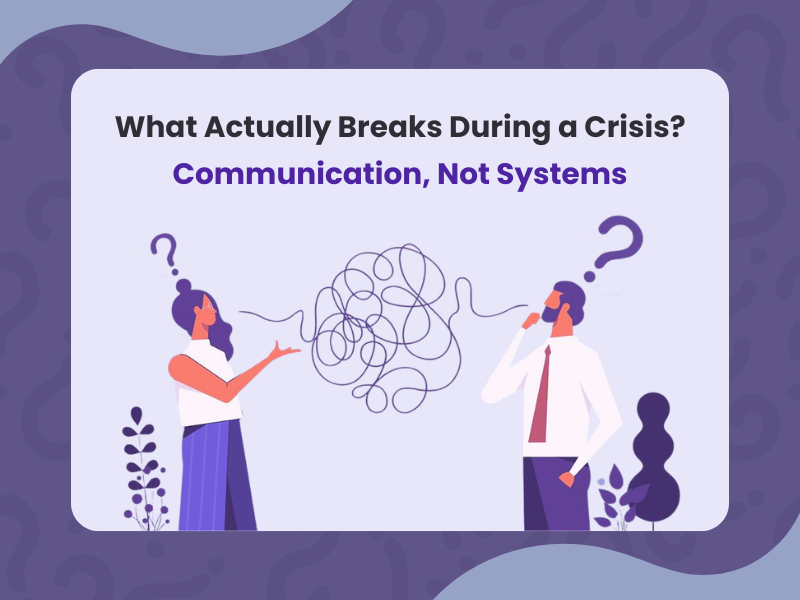
What Actually Breaks During a Crisis? Communication, Not Systems.
When a crisis hits, organizations instinctively look at systems — what failed, what stopped, what was breached.
But in most cases, systems don’t collapse first.
Communication does.
And once communication breaks, even a controlled incident can escalate into widespread disruption.
The Early Stage: Where Confusion Begins
In the first moments of a crisis:
- Systems are often still running (partially)
- Data is still available
- Teams are ready to respond
But:
- Understanding is inconsistent
- Information is incomplete
- Assumptions start filling the gaps
People don’t act on reality — they act on their interpretation of it.
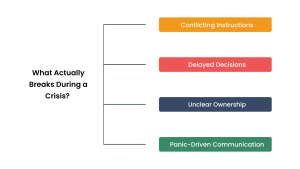
Breakdown Pattern 1: Conflicting Instructions
As urgency increases, multiple directions emerge simultaneously:
- IT pushes to isolate systems immediately
- Operations pushes to maintain continuity
- Leadership asks for rapid updates and minimal disruption
What this creates:
- Teams receive mixed signals
- Execution slows due to confusion
- Actions begin to contradict each other
Impact:
- Response loses coordination
- Time is wasted resolving internal conflict
- The incident expands unnecessarily
Breakdown Pattern 2: Delayed Decisions
Crises demand speed — but organizations often default to caution:
- Waiting for complete information
- Seeking multiple approvals
- Avoiding accountability for high-risk decisions
What this leads to:
- Critical response windows are missed
- Threats or issues remain active longer
- Small problems grow into larger incidents
Reality:
- Delayed decisions are not neutral
- Inaction is often the most damaging action
Breakdown Pattern 3: Unclear Ownership
When roles are not predefined, responsibility becomes blurred:
- No clear incident leader
- Multiple stakeholders assume ownership informally
- Critical tasks are not explicitly assigned
What happens next:
- Some tasks are duplicated
- Others are completely ignored
- No one has full visibility
Impact:
- Execution becomes fragmented
- Accountability disappears
- Progress becomes inconsistent
Breakdown Pattern 4: Panic-Driven Communication
As pressure increases, communication becomes reactive instead of structured:
- Message volume increases rapidly
- Context and clarity decrease
- Emotional tone begins to dominate
What this creates:
- Important updates get buried
- Teams struggle to identify priorities
- Decisions are made on incomplete or incorrect information
Result:
- Communication adds noise instead of clarity
The Core Issue: Misalignment
All breakdown patterns lead to one central failure:
Misalignment
Misalignment occurs when:
- Teams operate on different assumptions
- Leaders receive inconsistent updates
- Actions are not coordinated
What misalignment causes:
- Conflicting efforts across teams
- Slower and inefficient response
- Increased operational and reputational damage
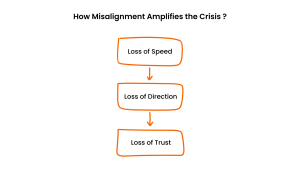
How Misalignment Amplifies the Crisis
A technical issue has limits.
Misalignment removes those limits.
It creates:
1. Loss of Speed
- Decisions take longer
- Actions are delayed
- Response momentum is lost
2. Loss of Direction
- Teams move in different directions
- Efforts conflict instead of align
3. Loss of Trust
- Internal confusion increases
- Leadership credibility is questioned
- External confidence drops
Why Communication Fails Before Systems?
Systems are designed for resilience:
- Redundancy
- Failover
- Monitoring
Communication is often not:
- No structured protocols
- No predefined ownership
- Heavy reliance on human judgment under stress
Under pressure:
- Systems follow design
- People follow perception
And perception breaks without clarity.
What Strong Crisis Communication Looks Like
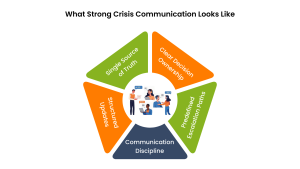
Organizations that manage crises effectively focus on communication control:
1. Single Source of Truth
- One verified channel for all updates
- Elimination of conflicting narratives
2. Clear Decision Ownership
- Defined leaders for decision-making
- Reduced ambiguity in authority
3. Structured Updates
- What happened
- What is known
- What is being done
- What is needed next
4. Predefined Escalation Paths
- Clear triggers for escalation
- Right people involved at the right time
5. Communication Discipline
- Focus on clarity over volume
- Prioritization of critical information
Leadership in a Crisis
In high-pressure situations, teams look for:
- Clear direction
- Consistent messaging
- Confidence in leadership
They do not expect perfect answers — they expect clarity.
Final Insight
A crisis does not become severe because of the incident alone.
It becomes severe when:
- Communication breaks
- Alignment is lost
- Execution fragments
Systems may fail but communication determines whether the organization stays in control or spirals into chaos.