Cloud Security Posture Management (CSPM): Why It’s Essential?
Introduction
As organizations increasingly migrate their workloads to the cloud, securing these environments becomes a critical priority. Traditional security measures are often insufficient to address the dynamic and distributed nature of cloud infrastructures. This is where Cloud Security Posture Management (CSPM) plays a vital role. CSPM solutions help organizations automate security monitoring, detect misconfigurations, and ensure compliance with industry regulations.
What is Cloud Security Posture Management (CSPM)?
CSPM is a category of security tools designed to identify, assess, and remediate risks across cloud environments. These solutions continuously monitor cloud configurations and detect vulnerabilities before they can be exploited. CSPM tools cover Infrastructure-as-a-Service (IaaS), Platform-as-a-Service (PaaS), and Software-as-a-Service (SaaS) deployments.
Key Functions of CSPM
- Misconfiguration Detection: Identifies insecure settings such as open ports, excessive permissions, or unencrypted data storage.
- Compliance Assurance: Ensures cloud environments meet regulatory frameworks like GDPR, HIPAA, and PCI-DSS.
- Threat Intelligence Integration: Leverages threat intelligence feeds to detect suspicious activities.
- Automated Remediation: Fixes security issues automatically or provides actionable insights for manual intervention.
- Visibility & Monitoring: Offers real-time insights into cloud assets, user activities, and security risks.
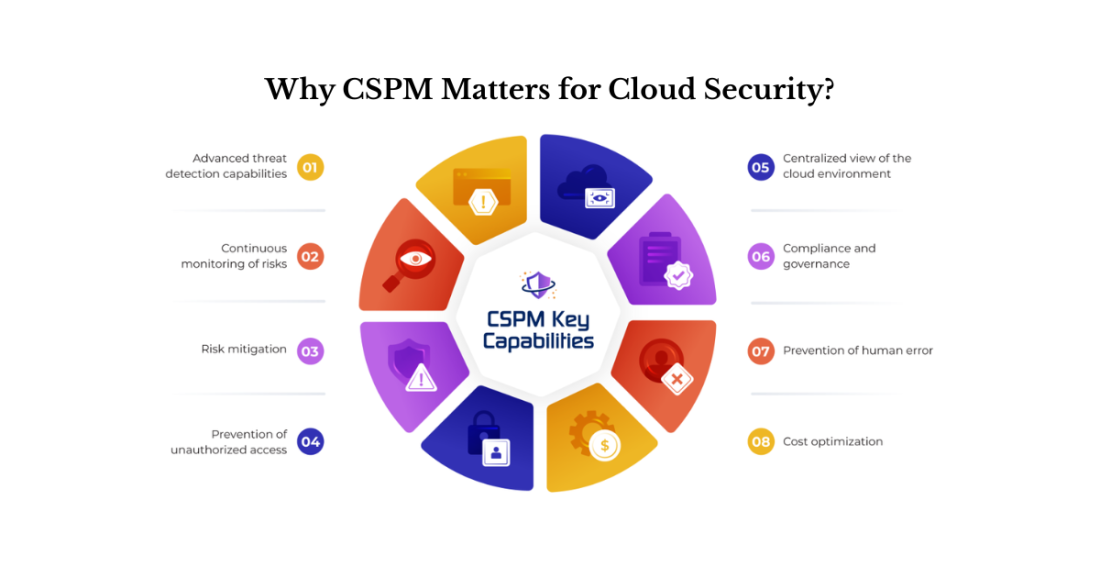
Why CSPM is Essential?
1. Prevents Cloud Misconfigurations
Cloud misconfigurations are one of the leading causes of data breaches. A simple error, such as leaving an S3 bucket publicly accessible, can expose sensitive information. CSPM continuously scans for these misconfigurations and alerts administrators before attackers can exploit them.
2. Ensures Compliance with Security Standards
Organizations must adhere to strict security frameworks like ISO 27001, NIST, CIS Benchmarks, and SOC 2. CSPM helps enforce compliance by automatically checking cloud environments against these standards and generating audit-ready reports.
3. Enhances Visibility Across Multi-Cloud Environments
Many businesses operate in a multi-cloud setup, using AWS, Azure, and Google Cloud. Managing security across multiple platforms can be complex. CSPM provides a unified view of security risks and compliance gaps, reducing blind spots.
4. Reduces Human Error
Manual security audits and configurations are prone to human error. CSPM automates security monitoring and minimizes the risk of accidental misconfigurations, improving overall security hygiene.
5. Detects & Responds to Threats Proactively
Cyber threats evolve rapidly, and waiting for a breach to occur can be disastrous. CSPM tools use AI-powered anomaly detection to spot suspicious activities such as unauthorized access attempts or unusual data transfers.
6. Supports DevSecOps & Shift-Left Security
Integrating security into the development process (Shift-Left security) is critical in cloud-native environments. CSPM solutions integrate with CI/CD pipelines, enabling developers to identify and remediate security risks before deployment.
Best Practices for Implementing CSPM
- Continuous Monitoring: Regularly scan cloud configurations for security risks.
- Automate Remediation: Use auto-remediation features to fix common misconfigurations instantly.
- Enforce Least Privilege Access: Limit user access based on roles and responsibilities.
- Enable Multi-Factor Authentication (MFA): Protect cloud accounts with MFA to prevent unauthorized access.
- Integrate with SIEM & SOAR Solutions: Enhance threat detection and response capabilities.
- Conduct Regular Security Audits: Evaluate cloud security posture through periodic assessments.
Conclusion
As cloud adoption accelerates, Cloud Security Posture Management (CSPM) is no longer optional but a necessity. Organizations that fail to address cloud security misconfigurations risk data breaches, compliance violations, and operational disruptions. By implementing CSPM, businesses can proactively identify risks, ensure regulatory compliance, and strengthen their overall security posture in the cloud. Investing in a robust CSPM strategy today will help safeguard your digital assets and maintain customer trust in an increasingly cloud-driven world.