Automated Machine Learning (AutoML): Revolutionizing AI Development in 2025
As machine learning continues to evolve, businesses are facing increasing pressure to harness its power to drive innovation, efficiency, and growth. Traditionally, developing machine learning models has been a labor-intensive process requiring specialized knowledge and significant time investment. In response, a transformative technology known as Automated Machine Learning (AutoML) has emerged, enabling organizations to streamline and accelerate the machine learning lifecycle. This blog explores AutoML in detail, its current capabilities, recent advancements, real-world applications, and best practices for adoption.
What is AutoML?
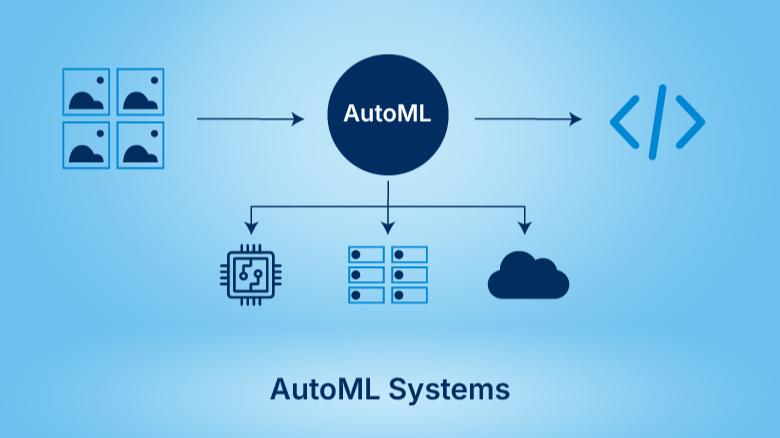
Automated Machine Learning, or AutoML, is a set of tools and techniques that automate the process of building machine learning models. It covers the entire machine learning pipeline, including:
- Data preprocessing and cleaning
- Feature engineering and selection
- Model selection
- Hyperparameter tuning
- Model evaluation and validation
- Deployment and monitoring
AutoML platforms enable users with varying technical backgrounds to build high-performing models with minimal manual intervention. It empowers both data scientists and non-experts by reducing the complexity and time associated with model development.
Why AutoML is Crucial in 2025?
In today’s fast-paced digital environment, the ability to generate insights quickly and accurately is a competitive differentiator. AutoML is crucial because it:
1. Democratizes Machine Learning
AutoML tools allow business users and citizen data scientists to create predictive models without needing in-depth programming or statistical knowledge.
2. Speeds Up Model Development
Tasks that once took weeks can now be completed in a matter of hours or even minutes. This speed is critical for businesses that need to respond rapidly to market changes.
3. Improves Accuracy and Consistency
AutoML leverages state-of-the-art algorithms and best practices to produce consistently accurate models, reducing the risk of human error.
4. Enhances Scalability
Organizations can scale their machine learning efforts across departments and use cases without exponentially increasing resource requirements.
5. Integrates with MLOps
Modern AutoML platforms are designed to integrate seamlessly with machine learning operations (MLOps), providing features like model versioning, monitoring, and CI/CD pipelines.
Key AutoML Advancements in 2025
The AutoML landscape is advancing rapidly. Here are some of the most significant developments shaping the field this year:
Foundation Models and Transfer Learning
AutoML platforms now incorporate pre-trained foundation models for tasks in NLP, computer vision, and generative AI. Users can fine-tune these models on domain-specific data, significantly improving performance with less labeled data.
On-Device and Edge AutoML
With the proliferation of edge devices, AutoML tools are now optimized for creating lightweight models that can run efficiently on mobile devices, sensors, and embedded systems, enabling real-time inference.
Explainable AutoML
Transparency is critical in regulated industries. AutoML tools now include built-in explainability features that help users understand how models make decisions, identify biases, and ensure fairness.
Hybrid Interfaces: No-Code and Code-Friendly
Platforms increasingly support both no-code interfaces for business users and APIs/Python SDKs for developers. This flexibility fosters better collaboration across teams.
Integrated MLOps and Continuous Learning
AutoML is now embedded in end-to-end machine learning pipelines, supporting automated retraining, performance tracking, and deployment through integrated MLOps features.
Popular AutoML Platforms in 2025
Some of the most widely adopted AutoML tools today include:
- Google Cloud AutoML / Vertex AI – Robust for vision, text, and tabular data; integrates with Google ecosystem
- AWS SageMaker Autopilot – Offers full automation and MLOps capabilities in the AWS environment
- DataRobot – Enterprise-focused platform with strong explainability and governance features
- H2O Driverless AI – Open-source leader known for speed and scalability
- Microsoft Azure AutoML – Seamless integration with Azure and strong support for developers and analysts
Real-World Applications of AutoML
AutoML is making a tangible impact across multiple industries:
Healthcare
- Predict patient risk scores and disease progression
- Enhance diagnostics using image recognition
Finance
- Detect fraud in transactions with real-time anomaly detection
- Score credit risk with high transparency
Retail
- Forecast demand with high granularity
- Personalize customer experiences based on behavior predictions
Manufacturing
- Predict equipment failure using time-series data
- Optimize supply chain and inventory management
Telecommunications
- Churn prediction and customer segmentation
- Network optimization using predictive maintenance
Best Practices for Adopting AutoML
To fully leverage AutoML, organizations should consider the following best practices:
Invest in Data Quality
Even the best AutoML platforms can’t compensate for poor-quality data. Ensuring accurate, clean, and relevant data is essential.
Define Clear Objectives
Be specific about what you want the model to achieve. Whether it’s classification, regression, or forecasting, clear goals guide better outcomes.
Maintain Human Oversight
AutoML does not eliminate the need for domain expertise. Collaborate closely with data scientists and domain experts to validate models and avoid pitfalls.
Monitor Models Post-Deployment
Use integrated MLOps tools to track performance, detect drift, and automate retraining if necessary.
Start Small, Scale Fast
Begin with high-impact, low-complexity use cases to prove value, then expand adoption across the organization.
The Future of AutoML
Looking ahead, AutoML will likely evolve in the following directions:
- Agentic AI integration: AutoML-powered agents that can reason, plan, and take autonomous actions
- Greater personalization: Models that adapt to specific user behaviors or microsegments
- Stronger privacy: AutoML methods that preserve privacy through techniques like federated learning
- Cross-domain modeling: Tools that can blend vision, text, and tabular data seamlessly
Conclusion
Automated Machine Learning is no longer a luxury or experimental tool – it’s a critical asset for organizations aiming to stay ahead in a data-driven world. In 2025, AutoML is helping companies accelerate innovation, reduce costs, and empower more people to harness the power of AI.
By choosing the right tools, ensuring data quality, and aligning with business goals, organizations can unlock the full potential of AutoML and drive transformative outcomes.