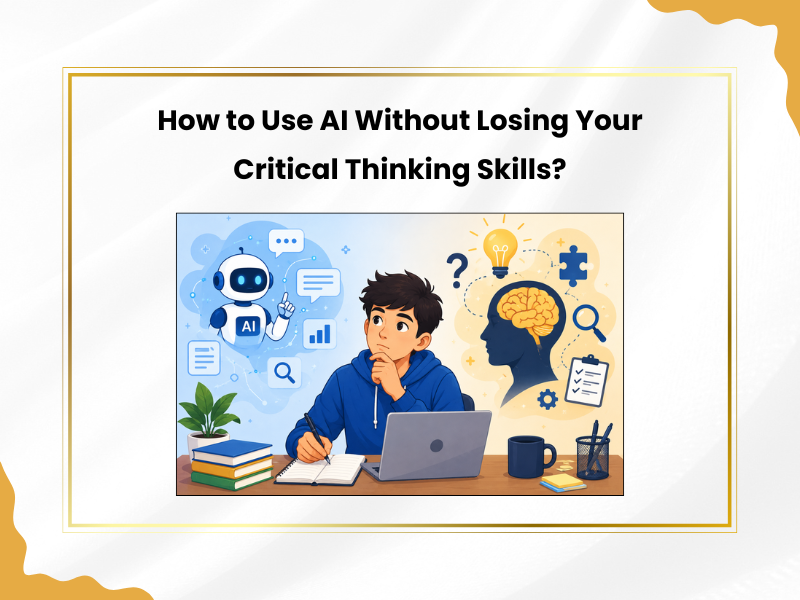
How to Use AI Without Losing Your Critical Thinking Skills?
A Deeper, Practical Guide for the AI-First Era
Artificial Intelligence is no longer a tool you use occasionally. It has become an integral part of how we write, research, plan, code, and even make decisions.
That shift introduces a quiet but significant risk—not that AI makes us wrong, but that it encourages us to stop questioning whether we are right.
Critical thinking doesn’t disappear overnight. It gradually erodes through overreliance, convenience, and repetition.
This guide explores how to embrace AI while preserving one of your most valuable skills: the ability to think critically.
1. The Real Problem Isn’t AI—It’s “Thinking Delegation”
Many people assume the greatest risk of AI is that it provides incorrect answers.
The deeper issue is this:
We are gradually delegating judgment—not just tasks.
At first, the pattern seems harmless:
- AI writes a draft, and you edit it.
- AI summarizes information, and you read it.
- AI suggests ideas, and you choose one.
Over time, however, the workflow changes:
- You stop creating your own first draft.
- You stop reading original sources.
- You stop generating alternative ideas.
This is thinking atrophy driven by convenience—not ignorance.
The real danger isn’t depending on AI for answers.
It’s depending on AI to frame your thinking process.
2. The Cognitive Skill You Must Protect: First-Principles Thinking
Critical thinking is more than simply being skeptical.
At its core, it is the ability to:
- Break problems into smaller parts.
- Question assumptions.
- Rebuild understanding from fundamental principles.
AI excels at:
- Pattern recognition
- Summarization
- Information synthesis
However, it cannot fully understand:
- Your specific context
- What matters most in your situation
- The responsibility behind your decisions
That gap is where human judgment must remain active.
3. The Modern Workflow Problem: “Answer Addiction”
AI creates a subtle psychological shift.
Instead of asking:
“What do I think about this?”
We begin asking:
“What does AI think about this?”
Over time, this creates answer addiction:
- Discomfort with ambiguity
- Impatience with slow thinking
- Preference for quick certainty
Yet most real-world challenges rarely provide instant clarity.
The ability to remain comfortable with uncertainty is becoming a valuable competitive advantage.
4. The THINK–ASSIST–VERIFY–OWN Framework
A structured approach to using AI without losing your ability to think independently.
Step 1: THINK (Before AI)
Spend just two to five minutes developing your own perspective.
Ask yourself:
- What do I already know?
- What do I believe is true?
- What outcome am I trying to achieve?
- What are the potential risks?
Even imperfect thinking matters.
This prevents AI from becoming the starting point of your reasoning.
Step 2: ASSIST (Use AI as an Expansion Tool)
Now invite AI into the process.
Use it for:
- Expanding ideas
- Generating alternatives
- Structuring thoughts
- Exploring different perspectives
A simple rule:
Never ask AI a question you haven’t thought about first.
Instead of asking:
“What should I do about X?”
Try asking:
“Here’s my thinking about X. What am I missing?”
This transforms AI from a decision-maker into a thinking partner.
Step 3: VERIFY (Apply Critical Evaluation)
This is where many users fall short.
Never accept AI output at face value.
Instead, ask:
- Does this align with reality or simply sound convincing?
- What assumptions are hidden here?
- What evidence would disprove this?
- Is this advice generic or specific to my context?
Develop one important habit:
Treat AI responses as confident drafts—not final truth.
Step 4: OWN (Keep Final Judgment Human)
The final decision should always remain yours.
You should be able to say:
“I made this decision after considering AI’s input—and I understand the reasoning behind it.”
If you can’t explain the logic yourself, you’ve outsourced your thinking.
5. When AI Should Lead—and When It Should Stay in the Background
Use AI extensively for:
Exploring new topics
- Learning unfamiliar concepts
- Generating ideas
- Mapping options
Handling high-volume tasks
- Summarizing documents
- Organizing notes
- Structuring content
Overcoming creative blocks
- Brainstorming headlines
- Drafting rough versions
- Suggesting frameworks
Reduce AI dependence when:
The decision has long-term consequences
- Career choices
- Financial strategies
- Leadership decisions
The context is deeply human
- Relationships
- Organizational dynamics
- Negotiations
The problem itself is ambiguous
If the problem isn’t clearly defined, AI may impose premature structure that limits better solutions.
6. The Hidden Risk: Fluent but Incorrect Thinking
One of AI’s greatest strengths can also become one of its greatest weaknesses.
It often presents incorrect answers with flawless structure and confident language.
This creates false confidence.
People stop questioning because:
- It sounds logical.
- It’s well-written.
- It confirms what they already believe.
Never confuse clarity of expression with correctness of thinking.
7. The Pre-Mortem Thinking Test
Before accepting AI’s recommendation, perform a simple mental exercise.
Imagine the decision failed.
Then ask yourself:
- Why did it fail?
- Which assumptions proved incorrect?
- What context did we overlook?
- What would a thoughtful critic point out?
This approach encourages deeper reasoning instead of automatic agreement.
8. Daily Habits That Strengthen Critical Thinking
Write Before You Prompt
Before asking AI, write:
- Your answer
- Your reasoning
- Your assumptions
Then compare your thinking with AI’s suggestions.
Ask AI to Challenge You
Instead of only asking for assistance, ask:
“Critique my reasoning.”
This builds intellectual resilience.
Request Multiple Perspectives
Ask:
“Give me three competing viewpoints.”
This reduces confirmation bias and broadens your thinking.
Rewrite AI Output in Your Own Words
Don’t copy.
Reconstruct.
If you can’t explain it in your own words, you haven’t truly understood it.
9. The “AI Intern” Principle
One useful mental model is to think of AI as an exceptionally capable intern.
AI is:
- Extremely fast
- Highly knowledgeable
- Exceptionally productive
But it is also:
- Context-limited
- Unable to carry responsibility
- Dependent on your direction
Your role is to:
- Set the direction.
- Evaluate the output.
- Make the final decisions.
- Accept responsibility for the outcome.
AI’s role is to support your thinking—not replace it.
If the intern starts making the final decisions, the system has failed.
10. The Real Future Skill: Thinking in an Age of Abundance
We’re entering a world where:
- Information is unlimited.
- Answers are instant.
- Explanations are always available.
In that environment, intelligence is no longer defined by knowing more.
Instead, it is defined by the ability to think clearly despite an abundance of information.
Those who can pause, question assumptions, evaluate evidence, and reason independently will possess an increasingly valuable advantage.
Final Thoughts
AI isn’t reducing human intelligence.
But it is changing how easily we surrender it.
The goal isn’t to use AI less.
The goal is to use it more intentionally.
AI should become an extension of your thinking—not a replacement for it.
Because in the end, your greatest competitive advantage won’t be speed.
It will be your ability to think clearly, ask better questions, and make sound judgments—even when everything else is thinking for you.