Beginner’s Guide to NLP: Core Concepts and Real-Life Applications
Introduction: Why Understanding Your Mind Changes Everything?
Every day, you make decisions, respond to people, handle pressure, and communicate ideas. But have you ever noticed that your reaction to situations is not always consistent?
- Sometimes you stay calm, other times you react quickly
- Sometimes you feel confident, other times unsure
- Sometimes communication flows, other times it breaks down
This inconsistency doesn’t happen by chance—it comes from how your mind processes experiences.
Neuro-Linguistic Programming (NLP) provides a structured way to understand these processes. It helps you recognize how your thoughts, language, and behavior are connected—and how small changes in these areas can lead to better outcomes.
This guide goes deeper into NLP so you not only understand it—but also know how to apply it effectively in real life.
What is NLP?
NLP is not just a concept—it is a practical framework for understanding human behavior.
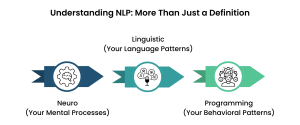
It focuses on three interconnected elements:
1. Neuro (Your Mental Processes)
This refers to how you experience the world through your senses:
- What you see
- What you hear
- What you feel
Your brain processes this information and creates meaning.
2. Linguistic (Your Language Patterns)
Language works at two levels:
- External communication (what you say to others)
- Internal dialogue (what you say to yourself)
Your internal dialogue is especially powerful—it shapes your confidence, decisions, and reactions.
3. Programming (Your Behavioral Patterns)
Over time, your brain develops patterns based on:
- Past experiences
- Repeated behaviors
- Learned responses
These patterns become automatic.
Example:
- If you repeatedly associate presentations with stress, your brain “programs” anxiety as the default response.
Simple Understanding
NLP helps you recognize these patterns and gives you ways to adjust them—so your responses become more intentional instead of automatic.
How Your Mind Processes Experiences?
To truly understand NLP, you need to understand what happens between an event and your response.
The Full Internal Process
Event → Sensory Input → Filtering → Interpretation → Emotion → State → Behavior → Result
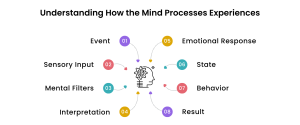
Let’s explore this step-by-step:
1. Event (What Actually Happens)
This is the external reality:
- A conversation
- A message
- A situation
Important:
The event itself is neutral. It doesn’t carry meaning until you interpret it.
2. Sensory Input (How You Experience It)
You experience events through your senses:
- Visual (what you see)
- Auditory (what you hear)
- Kinesthetic (what you feel)
3. Mental Filters (Why People Think Differently)
Before you assign meaning, your brain filters information using:
- Past experiences
- Beliefs
- Values
- Expectations
These filters explain why two people can interpret the same situation differently.
Example:
A short reply in a message:
- One person thinks: “They’re upset”
- Another thinks: “They’re busy”
4. Interpretation (Meaning Creation)
After filtering, your brain assigns meaning.
This is where most misunderstandings begin.
Because:
- The meaning feels real
- But it may not be accurate
5. Emotional Response
Your interpretation creates your emotional state:
- Negative meaning → stress, frustration
- Neutral/positive meaning → calm, curiosity
6. State (Your Overall Condition)
Your “state” includes:
- Emotions
- Physical posture
- Energy level
This state directly affects how you respond.
7. Behavior (Your Action or Reaction)
Based on your state, you:
- Speak
- Act
- Respond
8. Result (Outcome You Create)
Your behavior produces results:
- Productive conversation
- Miscommunication
- Progress or delay
Key Insight
You don’t control events—but you can influence interpretation, state, and response.
This is where NLP becomes powerful.
Core NLP Principles
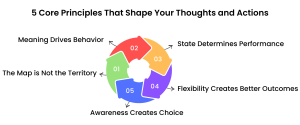
1. The Map is Not the Territory
Your understanding of reality is a “map”—not the actual reality.
- Your map is shaped by your experiences
- Someone else’s map is different
Why this matters:
It helps you:
- Avoid assumptions
- Stay open to other perspectives
2. Meaning Drives Behavior
People don’t react to events—they react to the meaning they assign.
Change the meaning → Change the response
3. State Determines Performance
Your emotional and mental state directly impacts:
- Communication
- Decision-making
- Problem-solving
Managing your state is more important than controlling situations.
4. Flexibility Creates Better Outcomes
If one approach doesn’t work:
- Adjust your thinking
- Try a different response
Rigid behavior leads to repeated problems. Flexible behavior creates solutions.
5. Awareness Creates Choice
When you are unaware:
- You react automatically
When you are aware:
- You can choose your response
Important NLP Concepts Explained Clearly
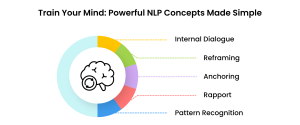
1. Internal Dialogue (Self-Talk)
Your internal voice influences:
- Confidence
- Stress levels
- Decision-making
Example:
- “I always mess this up” → creates hesitation
- “I can handle this step by step” → creates focus
2. Reframing (Changing Perspective)
Reframing doesn’t change reality—it changes how you view it.
Example:
- “This is a failure” → “This is feedback for improvement”
3. Anchoring (Triggering Emotional States)
Your brain links experiences with emotions.
Example:
- A certain place makes you feel calm
- A specific memory creates confidence
You can create anchors intentionally.
4. Rapport (Building Connection)
Rapport is about:
- Understanding others
- Creating trust
- Aligning communication styles
It improves collaboration and reduces conflict.
5. Pattern Recognition
NLP helps you notice:
- Repeated reactions
- Emotional triggers
- Communication habits
Once identified, these patterns can be adjusted.
Real-Life Applications
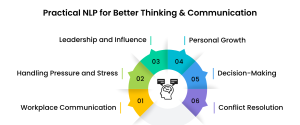
1. Workplace Communication
NLP helps you:
- Avoid misunderstandings
- Structure conversations clearly
- Respond instead of reacting
2. Handling Pressure and Stress
By managing your internal state:
- You stay calm
- Think clearly
- Make better decisions
3. Leadership and Influence
Leaders benefit from NLP by:
- Understanding team behavior
- Communicating effectively
- Managing conflicts
4. Personal Growth
You can:
- Replace limiting beliefs
- Build confidence
- Improve consistency
5. Decision-Making
Instead of reacting emotionally:
- You evaluate situations objectively
- Make more balanced decisions
6. Conflict Resolution
NLP shifts conversations from:
- Blame → Understanding
- Reaction → Resolution
Practical Exercises
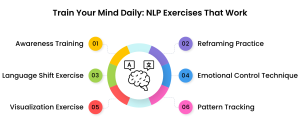
1. Awareness Training
At different moments, pause and ask:
- What am I thinking?
- What am I feeling?
- Why am I reacting this way?
2. Reframing Practice
When facing a challenge:
- List 3 alternative interpretations
- Choose the most constructive one
3. Language Shift Exercise
Notice negative phrases and adjust them:
- “This is stressful” → “This needs a clear plan”
- “I can’t do this” → “I’ll figure this out step by step”
4. Emotional Control Technique
When triggered:
- Pause
- Take a breath
- Identify the emotion
- Choose a response
5. Visualization Exercise
Before important tasks:
- Imagine the process clearly
- Visualize success
- Focus on calm and confidence
6. Pattern Tracking
At the end of the day, reflect:
- Where did I react automatically?
- What could I do differently next time?
Common Misconceptions About NLP
- It’s not about controlling others
- It’s not instant transformation
- It’s not complex theory—it’s practical application
How to Start Using NLP Effectively?
Start with:
- Awareness of thoughts
- Small language changes
- Pausing before reacting
Then gradually:
- Apply reframing
- Improve communication habits
- Manage emotional states
Final Thoughts
NLP is not about adding something new to your life—it’s about understanding what is already happening in your mind.
When you become aware of:
- How you interpret situations
- How your emotions influence behavior
- How your language shapes thinking
You gain the ability to respond with clarity instead of reacting automatically.
And that changes everything.