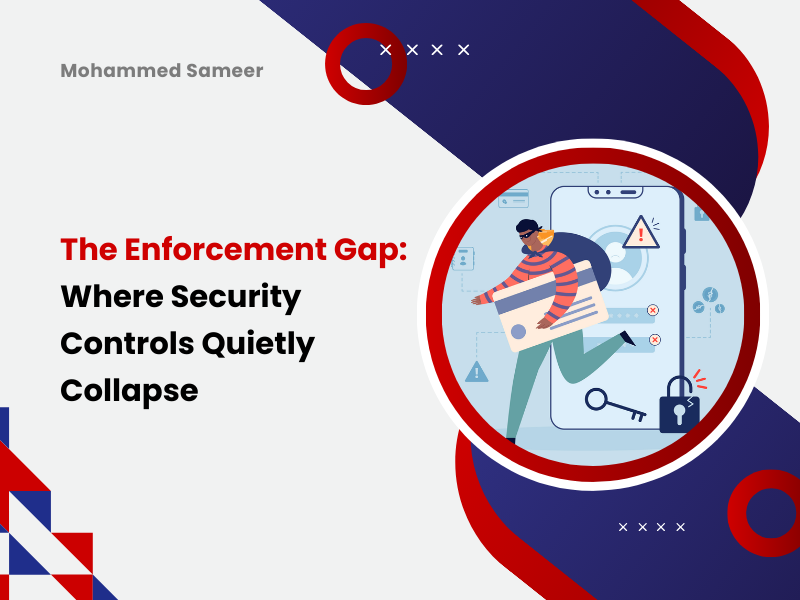
The Enforcement Gap: Where Security Controls Quietly Collapse
Most security failures don’t begin with attackers.
They begin internally — in the space between what is defined and what is enforced.
Organizations invest heavily in frameworks, policies, tools, and dashboards. On paper, controls exist. Audits pass. Reports look reassuring. Yet breaches, outages, and regulatory findings still occur — often in environments that appeared “well governed.”
This disconnect is known as the enforcement gap.
It is the silent erosion of security controls after they are designed, approved, and deployed — when enforcement weakens, accountability blurs, and risk quietly accumulates.
This blog examines where enforcement commonly collapses, why it goes unnoticed, and how mature organizations close the gap.
Understanding the Enforcement Gap
The enforcement gap emerges when:
- Policies exist but are not consistently applied
- Controls are deployed but not validated
- Exceptions become permanent
- Ownership of risk becomes diffuse
Security posture degrades not through dramatic failure, but through gradual normalization of weakness.
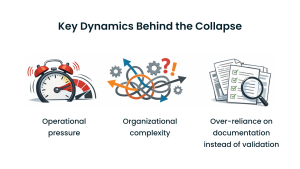
Three dynamics drive this collapse:
- Operational pressure
- Organizational complexity
- Over-reliance on documentation instead of validation
The result is a control environment that looks strong but behaves unpredictably under stress.
1. Exception Creep: When Temporary Becomes Permanent
Every organization allows exceptions.
They are sometimes necessary for business continuity.
The problem arises when exceptions:
- Are repeatedly extended
- Lack expiration dates
- Are approved without compensating controls
- Are never re-evaluated for relevance
Over time, exceptions stop being deviations — they become the operating model.
Why Exception Creep Is Dangerous?
- Risk accumulates invisibly
- Control baselines fragment
- Teams lose clarity on what “standard” even means
- Audits focus on approvals, not outcomes
Exception creep signals a deeper issue:
controls are being adapted to the business instead of the business adapting to controls.
2. Unmanaged Privileged Access: The Quietest High-Impact Risk
Privileged access remains one of the most consistently exploited attack vectors — not because controls don’t exist, but because enforcement weakens over time.
Common enforcement failures include:
- Standing administrative access without justification
- Privileges granted “temporarily” and never revoked
- Shared accounts with no clear ownership
- Infrequent access reviews treated as checklist exercises
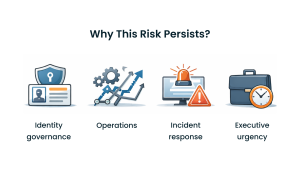
Why This Risk Persists?
Privileged access sits at the intersection of:
- Identity governance
- Operations
- Incident response
- Executive urgency
When enforcement is weak, privilege becomes convenience-driven rather than risk-driven.
The most dangerous accounts are often the least visible ones.
3. Inconsistent Monitoring: Partial Visibility Creates False Confidence
Monitoring is often assumed to be universal — but in reality, it is frequently fragmented.
Signs of enforcement breakdown include:
- Critical systems excluded from logging
- Legacy platforms not integrated into monitoring tools
- Inconsistent alert thresholds across environments
- Manual log reviews without accountability
The Illusion of Coverage
Dashboards may show activity, but:
- Blind spots remain undocumented
- Detection varies by platform
- Incident response maturity depends on where the event occurs
Inconsistent monitoring does not just delay detection —
it creates selective enforcement, where some risks are visible and others are invisible by design.
4. Policy Documentation Without Validation
Policies are foundational — but documentation alone does not equal control.
A common enforcement failure occurs when:
- Policies are approved but never tested
- Control statements are assumed to be true
- Compliance is assessed via attestation instead of evidence
- Ownership ends once the policy is published
Why This Is So Common?
Documentation satisfies:
- Audit requirements
- Regulatory expectations
- Governance optics
Validation, however, requires:
- Technical testing
- Operational disruption
- Cross-team coordination
- Willingness to surface uncomfortable truths
Without validation, policies become aspirational narratives, not enforceable safeguards.
How the Enforcement Gap Stays Hidden?
The enforcement gap persists because:
- Metrics measure activity, not effectiveness
- Reporting favors stability over truth
- Risk ownership is diffused across teams
- Failures emerge slowly, not suddenly
By the time enforcement failures are visible externally — through incidents, breaches, or regulatory action — they have often existed internally for years.
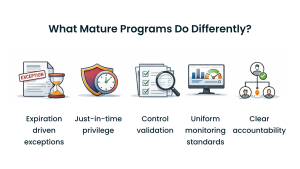
Closing the Enforcement Gap: What Mature Programs Do Differently?
High-resilience organizations treat enforcement as a continuous discipline, not a one-time exercise.
They focus on:
- Expiration-driven exceptions, not open-ended approvals
- Just-in-time privilege, not standing access
- Control validation, not policy existence
- Uniform monitoring standards, not tool coverage
- Clear accountability, not shared responsibility
Most importantly, they ask better questions:
- Is this control still enforced — or just documented?
- When was it last tested?
- What breaks if it fails?
- Who owns the risk if enforcement degrades?
Final Thought
Security controls rarely fail loudly.
They fail quietly — through erosion, exceptions, and assumptions.
The enforcement gap is not a tooling problem.
It is a governance and accountability problem.
Organizations that close this gap don’t just look compliant —
they remain resilient when pressure is highest.