Why Well-Designed Security Strategies Fail During Execution?
Most large organizations today do not suffer from a lack of security strategy.
They have frameworks, roadmaps, maturity models, and multi-year investment plans.
Yet breaches, control failures, audit findings, and chronic risk exposure persist.
The problem is rarely strategy quality.
It is execution breakdown.
Well-designed security strategies fail not because they are wrong—but because they are misaligned with operational reality, diluted by unclear accountability, distorted by misleading dashboards, and abstracted away from technical ground truth.
This blog explores the systemic reasons why security strategies collapse during execution—and why fixing them requires structural, not cosmetic, change.
1. Strategic Intent vs. Operational Reality
Security strategies are often conceived at an altitude where operational friction is invisible.
At the strategy level, objectives sound clear:
- “Reduce cyber risk”
- “Strengthen identity and access controls”
- “Improve incident response maturity”
- “Adopt Zero Trust principles”
But when these intentions reach the operational layer, they collide with reality:
- Legacy systems that cannot support modern controls
- Understaffed teams juggling firefighting and transformation
- Tool sprawl without integration
- Business processes that prioritize speed over control
The strategy assumes ideal conditions.
Operations live in constraints.
As a result:
- Controls are implemented partially
- Exceptions become permanent
- Compensating controls are theoretical
- Risk acceptance becomes informal and undocumented
Execution does not fail loudly—it quietly degrades.
The organization believes it is “on the journey,” while exposure remains unchanged.
2. Unclear Accountability at the Execution Level
One of the most common—and least discussed—causes of strategy failure is ambiguous ownership.
Security strategies often assign responsibility at a high level:
- “The business owns risk”
- “IT implements controls”
- “Security provides oversight”
But at execution time, critical questions have no clear answers:
- Who is accountable when a control is partially implemented?
- Who owns risk created by operational shortcuts?
- Who decides when security objectives conflict with delivery deadlines?
- Who signs off when remediation is delayed?
Without named accountability at the execution layer, responsibility dissolves:
- Security teams advise but cannot enforce
- IT teams implement but do not own risk
- Business leaders consume dashboards but do not feel consequences
This creates a dangerous gap:
Everyone is involved, but no one is accountable.
Execution requires decision rights, not just role descriptions.
Without them, strategy becomes guidance—not governance.
3. Overconfidence Created by Dashboards and Metrics
Modern security programs are rich in metrics:
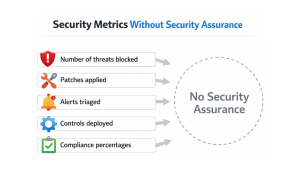
- Number of threats blocked
- Patches applied
- Alerts triaged
- Controls deployed
- Compliance percentages
These metrics create a false sense of confidence.
Dashboards show activity, not exposure.
They answer questions like:
- Are tools running?
- Are processes active?
- Are teams busy?
But they often fail to answer the only questions that matter:
- Are critical systems still vulnerable?
- Is privileged access actually controlled?
- Are crown-jewel assets defensible under attack?
- How long do high-impact gaps remain open?
When leadership sees green dashboards, urgency fades.
When urgency fades, execution weakens.
Over time, organizations begin managing the appearance of security, not its effectiveness.
The dashboard becomes the reality—even when it no longer reflects the risk landscape.
4. The Disconnect Between Leadership Reporting and Technical Ground Truth
Security reporting often improves as technical visibility worsens.
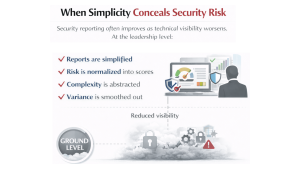
At the leadership level:
- Reports are simplified
- Risk is normalized into scores
- Complexity is abstracted
- Variance is smoothed out
At the technical level:
- Engineers see fragile systems
- Analysts see recurring control failures
- Architects see unresolved design debt
- Incident responders see the same root causes repeating
This creates two parallel realities:
- Executive reality: “Risk is managed and trending down”
- Operational reality: “We are one failure away from a serious incident”
Because these realities rarely meet, warning signals are muted.
Escalations soften.
Language becomes cautious.
Bad news is reframed as “ongoing improvement.”
Eventually, the organization is surprised—not by the existence of risk, but by its impact.
Breaches feel sudden, but they are usually long-predicted at the technical layer.
5. Strategy Without Enforcement Is Aspiration
Many security strategies rely on voluntary alignment:
- “Encourage secure development”
- “Promote least privilege”
- “Embed security into delivery”
But execution requires enforcement mechanisms:
- Gated processes
- Hard technical controls
- Funding tied to compliance
- Consequences for unmanaged risk
When strategies lack enforcement:
- Teams interpret controls differently
- Exceptions multiply
- Risk ownership becomes symbolic
- Security becomes negotiable under pressure
A strategy that cannot say “no” is not a strategy—it is a suggestion.
6. Security as a Program, Not an Operating Model
Another execution failure point is treating security as a program rather than an operating model.
Programs:
- Have start and end dates
- Focus on deliverables
- Optimize for completion
Operating models:
- Define how decisions are made
- Define who owns risk continuously
- Define how trade-offs are resolved
Many organizations complete security programs successfully—
yet return to the same risk posture months later.
Why?
Because the way the organization operates never changed.
Execution fails when strategy does not reshape:
- Incentives
- Decision authority
- Performance measures
- Escalation paths
Without this, security improvements decay over time.
7. The Cost of Ignoring Execution Reality
When execution gaps persist, organizations pay in hidden ways:
- Chronic operational friction
- Repeated audit findings
- Rising technical debt
- Talent burnout
- Loss of credibility with regulators and boards
Eventually, the cost becomes visible through:
- Material incidents
- Regulatory intervention
- Public trust erosion
- Emergency remediation at extreme cost
At that point, the strategy is questioned—but it was never the real problem.
8. Closing the Gap: From Strategy to Executable Security
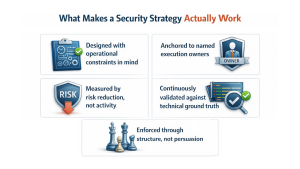
Security strategies succeed when they are:
- Designed with operational constraints in mind
- Anchored to named execution owners
- Measured by risk reduction, not activity
- Continuously validated against technical ground truth
- Enforced through structure, not persuasion
The most resilient organizations treat execution as a first-class design problem, not an afterthought.
They ask:
- “Who owns this risk on a bad day?”
- “What happens when controls are bypassed?”
- “What do engineers see that dashboards hide?”
- “How fast can we fix what truly matters?”
Final Thought
Security does not fail because organizations lack intent.
It fails when intent is disconnected from reality.
The gap between strategy and execution is where most cyber risk lives.
Closing that gap—not writing better strategies—is the real work of modern security leadership.